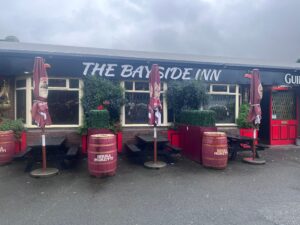
 It’s true we have a tendency to stick to pubs that are north of the Liffey, but we rarely venture out into the true suburbs – we are usually still within reasonable walking distance of Dublin city centre. This week, however, we take a longish bus ride out to the wilds of Kilbarrack to visit The Bayside Inn.
Although Kilbarrack itself does date back to the medieval period in some form, it is almost certainly best-known now for its alter ego, Barrytown, in the works of Roddy Doyle. And while we’re very much Roddy Doyle fans, there’s not much about the pub that we’d call a direct callback to one of his novels (or any of the films thereof), but it’s very much the kind of local spot that seems to have simply grown out of its nearby surroundings.
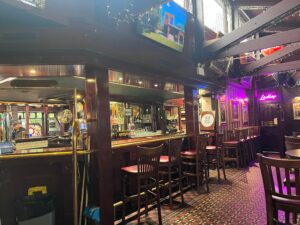 Indeed, The Bayside Inn is so ‘of this place’ that it sits in the car park in the shopping centre, next to the church – all of a thoroughly 1970s vintage. One gets the feeling that not much has changed in the internal décor since the doors opened in 1974 (per the painted gold letters on the half-glass doors. Some fairy lights have been added to the open rafters, and a taxidermied bear is observing proceedings from above, but beyond the TV screens, we doubt that much has been altered. It might not be a perfect time capsule from the 1970s, but it’s also not terribly far off. And while there may be very slight visual and architectural similarities to this particular vintage of ‘estate pubs’ on the Neighbouring Island, the feeling is still very much ‘neighbourhood Dublin pub’ – it doesn’t have a ‘locals only’ vibe, even if it does have plenty of regulars (which can, of course, be said of many estate pubs in Britain, even if that’s not the popular reputation).
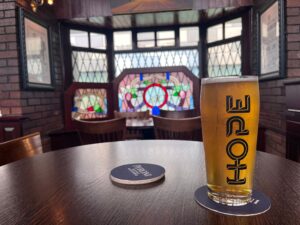 And some things have changed with the times; there is good support for local independent beer here, with fresh selections from Hope, brewed under 2 km away at Howth Junction, on tap. Yes, there’s Guinness and all the other usual options, but it’s nice to see smaller local businesses giving each other a helping hand. We confess we’ve only made it up here when we’ve been visiting local friends (or doing a spot of cat-sitting), but we’ve always felt very welcome here, even as only occasional drop-ins.
With so many Dublin pubs working hard to maintain a late 19th century look and feel (even if they are thoroughly modern establishments), it’s refreshing to see a spot that is simply itself; The Bayside Inn wears its 1970s font and decoration with pride.
Where: Bayside Blvd N, Kilbarrack Lower, Dublin
Access from the city centre: Dart to Bayside, H3 bus – this would be well over a 2 hour walk from town
Food: Pizza (more of the frozen and reheated variety)
Sport: So much sport!
TVs: Screens visible throughout the pub – an ideal spot for a match when several are on
Music: Television sound on the most recent visit, but we’ve heard 80s faves in the past
Family-friendliness: Kids welcome at the usual times
Pub-crawl-ability: Low – there is a scattering of ‘nearby’ pubs like The Elphin Bar or The Racecourse Inn, but it would make for a tough pub crawl; otherwise, hop the bus or train further out to Howth for The Harbour Bar or The Bloody Stream
Local sites of note: The Lamb Chop, Sutton Park, Bull Island
Haunted: The old fireplace looks to have been rescued from an older establishment; perhaps it brought a spooky friend?
Other notes: Dogs welcome; main floor toilets
Socials: Facebook, Instagram
 Yes, it’s yet another new pub this week, replacing one more short-lived but much-loved Dublin spot – we venture back to
 Indeed, it seems to have hit the sweet spot between newly-opened
 And while we couldn’t find any direct connection between Phil Lynott and pubs in this part of town – it would be a bit of a walk to
 Regular readers know that we tend to keep
 However, our midweek daytime visit was quite a different affair, and all to the good. Both the interior and the large beer garden were calm, though not empty – as we write this, it is
 That said, we are more likely to take ourselves to
 This week, we remain on the south side of Dublin with a visit to
 And it was a very pleasant discovery indeed – the Dark Arts was as fresh as promised, but there were other independent offerings as well, notably Sullivan’s Black Marble Stout from Kilkenny. There were several Changing Times beers, and while we
 It’s a very ‘pubby’ pub, with the usual dark woods and a lovely decorative ceiling. The atmosphere was very calming, certainly a change from the post-holiday shopping and pizza lines outside. It wasn’t quite full
 Rather like
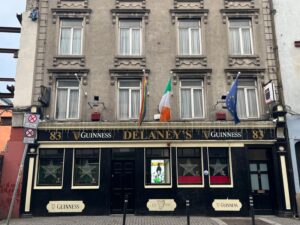 While Dublin city centre certainly has plenty of pubs, we are fortunate in also having additional parts of town that are also jam-packed with excellent options, especially when
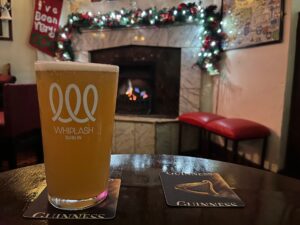 So, it’s taken us a while to get to Delaney’s, which has very much a ‘pubby’ pub feel, but it was worth the wait. There’s a wonderful fireplace for our current season, and a large back garden for less-chilly temperatures (though it is also heated); it is truly a pub that caters to the ever-changing weather – just mind the suit of armour by the back door. While the building was
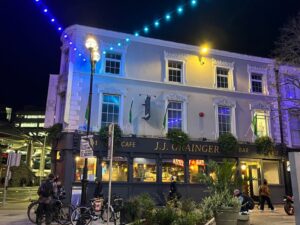 Dublin – indeed, Ireland – is not over-endowed with glorious (or even ‘fine’) train stations. Having recently
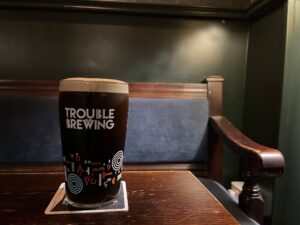
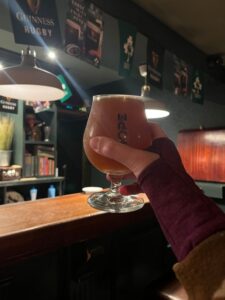 The staff were also friendly and welcoming – how many pubs would put on the ‘Airwolf’ theme when asked to do so (not, it must be said, by us, but we did enjoy it)? And while it’s true that this part of Dublin still has a bit of a ‘reputation,’ something we’ve discussed in our entry on
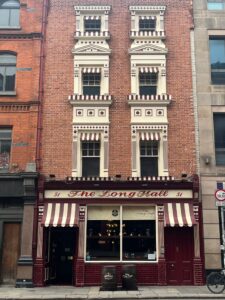 In our effort to fill in the blanks when we see you getting lost in our search results, we’re aiming to visit some of the more common pubs on the tourist trail here and there, now that the bulk of the summer holidaymakers have gone home. Indeed, this week’s pub is one we’ve only ever previously visited in that capacity, years before moving to Dublin: The Long Hall.
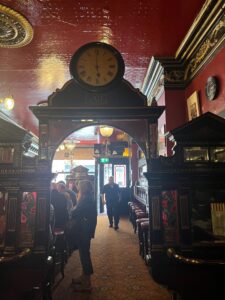 Visiting again with more ‘local’ eyes does make you notice different things, but the fundamentals remain the same: the beautifully-maintained – and, in this case, likely genuinely world-famous – exterior of the pub is unmistakable, with its signature red-and-off-white stripes. Inside, it’s the kind of high Victorian décor that is more commonly a pastiche these days, but The Long Hall comes by it honestly: its last real renovation was in the 1880s. And while the deep reds and dark woods are common to many other local Dublin pubs of this vintage – a subject to which we’ll return – there are unique features here, including the
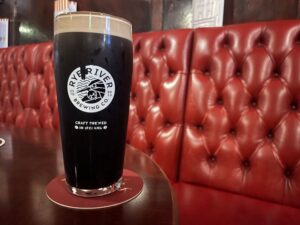
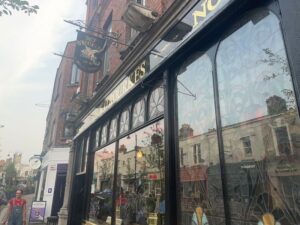 We know that we tend to be biased toward pubs on the north side of the Liffey, but this week, we travel (relatively) far into south Dublin – all the way to Blackrock and . Once a quiet fishing village with a sideline in
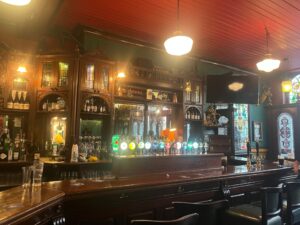 And while the
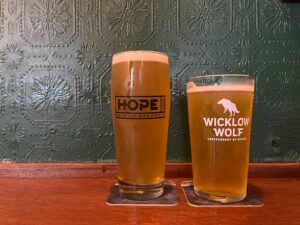 There are some lovely little snugs and the pub also has a bit of a nautical bent – the seafront is right here, after all – but it’s very welcoming to all; the standard Guinness (and Beamish!) is on offer, and there is good support for independent offerings like Hope and Wicklow Wolf, as well as
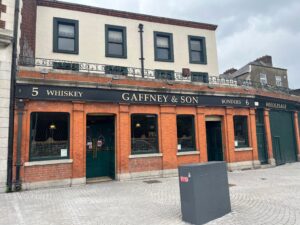 Dublin excels at
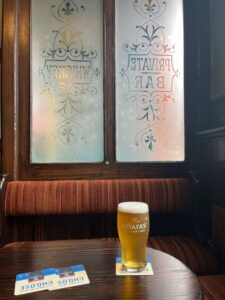 There’s a warm welcome, and not one, but two local independent beers offerings: Hope and O’Hara’s are always well-kept here. The bar serves two separate sections, each with their own respective snugs and other seating, and there are lots of little corners to duck into if you’re looking for that quiet solo pint. And it’s interesting to note that while everything you see now is very much hearkening back to the late 19th century, this is, in fact, an older pub – the original building(s) is/are Georgian, and its first license
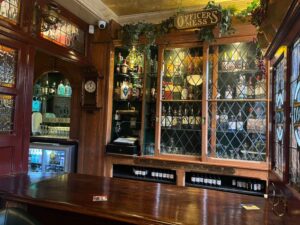 Our one knock on many Old Man Pubs is that they rarely offer any beers beyond the usual Guinness and Heineken (though to be fair, it’s usually an excellent Guinness from scrupulously clean tap lines), but as mentioned above, at Gaffney’s, there is good support for other choices, plus Beamish as another stout option. This beer selection, combined with the attractive interior, might just make it the perfect Dublin Old Man Pub.
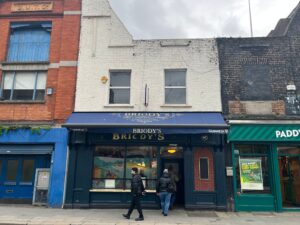 This week’s pub is one that we’ve both been asked to profile repeatedly, and, in nearly equal measure, begged not to reveal it as a secret hidden gem. Is it possible to satisfy both of these audiences? Let’s find out – and so, we venture back to Marlborough Street, home to
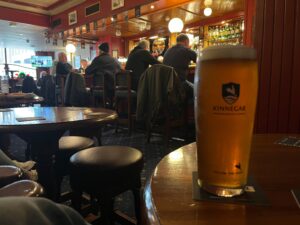 Also unlike many other Old Man Pubs, there was an independent beer option: Kinnegar’s Scraggy Bay. In some pubs that don’t have that kind of turnover for non-Guinness options, they aren’t always as fresh, but there were no such issues here. Guinness was, of course, plentiful, but there were many pints of lager being consumed, too – it is slightly unusual to see Tuborg on one of the taps in a Dublin pub, but I have a soft spot for many Carlsberg products, so it was quite welcome. The décor is, again, by no means fancy, but it’s very well-kept: red and cream paint, lighter wood tones and simple brass lamps on the bar. The crowd was clearly mostly regulars, and although most were deeply invested in the multiple channels of horse racing, there were other long-running conversations, too.
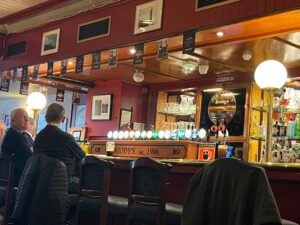 And while it may be true that this is not the cleanest nor most well-kept part of Dublin, that is presumably part of what keeps the tourists away, Georgian architecture notwithstanding. And although some parts of Reddit may be thoroughly convinced that we’re all just waiting to get murdered north of the Liffey, there are signs of positive development; newer pubs like The Morris Bar, just a short walk away, suggest that things are slowly improving. But for a pub like Briody’s that’s been here for over a century in various guises, it seems to be content to keep its current mix of regulars and semi-regulars who drop in whenever they are in town.