 It’s finally happened.
We didn’t have time to get to a new pub over the bank holiday weekend – too busy smashing the Dublin City Half Marathon – and so, we’ve had to dig deep into our occasionally-regrettable photo archives to find what we had lying about. This can only mean one thing – it’s Spoons time.
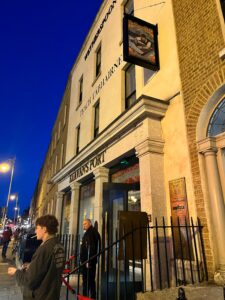
Although as a rule we tend to avoid Wetherspoons – easily done as there aren’t so very many of them in Ireland – occasionally, needs must. The Spoons in question is Keavan’s Port on Camden Street, and, if we put the sight of the bouncers (and some punters) to one side and focus only on the complex itself, it’s a huge achievement, and well worth visiting simply to explore the building(s). Now both pub and hotel, for many years, the Georgian townhouses that make up the site were derelict, with little of the previous history visible or accessible. And the history is fascinating: these buildings have housed a convent, a boxing gym, a stained-glass workshop (some of them concurrently) as well as their original residential intent.
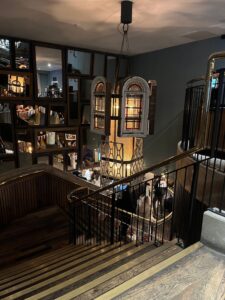 And the restoration work is truly wonderful – care has been taken throughout to honour the different eras and uses that have gone before, and there are explanatory panels and photos throughout the pub (if you keep an eye out). The attention to historical detail has been balanced out with accessibility measures – ramps, lifts and a variety of reasonably easy-to-navigate spaces, despite the multi-level, multi-space layout of the pub; it’s comparatively rare to find this much care given to these features in Dublin, even in many pub rebuilds.
And yet.
Despite the layers of local history, there is still a feeling that you could be in any Wetherspoons in, say, Loughborough. The ‘pub experience’ doesn’t feel local – it feels pre-packaged and generically, well, British. This is not inherently a bad thing – we love going to the UK to go pub-bothering there, especially if there’s good cask ale on. But the ones we tend to go to there (even if, as is so often the case there, part of a larger pubco) still feel like they have their own personalities and quirks. This may, of course, be very much self-selected, but a pub like Ye Old Mitre still feels like it has its own vibe, even if it’s part of the Fuller’s/Asahi empire, while the Spoons experience is much more akin to a global chain (especially when it comes to the always-underwhelming, presumably-microwaved food).
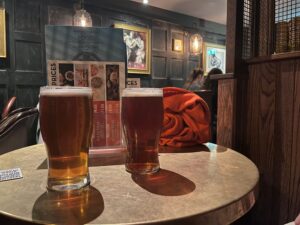 The cask offering is also a point of contention here – as cask nerds, we’ve noted before the very small number of pubs in Dublin that have any cask ale at all – on any given day, the ones you are most likely to find in action at a non-Wetherspoons are single cask lines at The Porterhouse and Harty’s Bar, respectively (though we have it on very good authority that another beer engine will soon be regularly with us at A New Pub…watch this space), while The Black Sheep has neglected this of late. And, indeed, there are up to 5 beer engines at Keavan’s Port, but on the several occasions we’ve tried, a good 3 of them have been out of service (with the working ones being rather unremarkable Greene King beers), whilst on other visits, the beers had actively gone off and were nearly straight-up vinegar. To be fair, we know others have not had this experience here, and we seem to be particularly unlucky, but it’s always proved disappointing for us.
Finally, though, there is the other main Wetherspoons selling point: the cost. You will not find cheaper pints in the city – €2.60 for a Worthington’s Creamflow, or €4.50 for a Beamish are hard to beat, which is a not-unreasonable point. It would just be nice if the experience felt more like a real ‘Dublin’ one, but if price is the main issue, that may not be relevant to many punters.
 Which, of course, leads us to the other reason we tend to not go there very much – it would be horrifying to the Young Adult member of the household to run into us at a place that is very much a usual haunt of His People; best to leave it to the Youth most of the time, but it is handy for a cheap pint before a gig nearby, and you can always make paper airplanes from the Wetherspoons magazine if you are so inclined. Just consider eating somewhere else beforehand…
Where: 1-5 Camden Street Upper, Dublin, IE D02 K854
Access from the city centre: Buses 9, 14, 15, 16, 27, 56A, 65B, 77A, 83, 140, 151, 15-ish minute walk
Food: Breakfast/lunch/dinner – the usual Wetherspoons options
Sport: All the sports
TVs: All over the place, though some areas are more subdued
Music: Quite a generic soundtrack of MOR tracks through the decades
Family-friendliness: There is the standard Spoons kids’ menu, but Camden Street can get rowdy at night
Pub-crawl-ability: High – Devitt’s, Anseo, Barebone, The Camden, Ryan’s of Camden Street, The Bleeding Horse, The Portobello Bar
Local sites of note: Whelan’s, Iveagh Gardens, St Stephen’s Green, National Concert Hall, Marsh’s Library, St Patrick’s Cathedral
Haunted: Definite ‘haunted object’ vibes in some sports
Other notes: One of only a few spots with truly accessible toilets throughout the building
Socials: N/A
 Back in the 1990s – before Trainspotting, as it happens – Robert Carlyle and Shirley Henderson starred in Hamish Macbeth, a vastly-underrated Scottish cosy crime comedy-drama, with a bit of quirky/folksy paranormal goodness thrown in here and there for good measure. In the show, Carlyle played the titular Macbeth, a police constable with an adorable Westie, a fondness for the odd herbal cigarette and a work ethic that isn’t overly-dedicated to solving crimes, but who, nonetheless, keeps his small, eccentric village in good order. Shirley Henderson’s character starts off as a relatively conventional love interest (this was, after all, the 1990s), but as with all the characters in this excellent show, we discover much more as we go along.
 In 2024, Dublin craft beer OG Against the Grain closed abruptly, not long after a renovation. What had been a friendly and welcoming Galway Bay pub with an excellent tap lineup of own-brand and guest beers was replaced by the wildly-underwhelming
  Although initial chatter was the Barebone would be ‘just a restaurant,’ we’re happy to report that it does still feel like a neighbourhood pub – but one that also happens to do quite good food. Yes, the décor has been upgraded even a smidgeon more – lots of dark tiles, mirrors and subtle brass fittings (including very handy coat/bag hooks, which we don’t see enough) – but it’s all thoroughly welcoming, both for the person stopping in for a quick (or not-so-quick) drink and their more relaxed-dinner counterpart. While the taplist isn’t quite as extensive as it was during the Galway Bay days, there were independent options from Hope, Whiplash and Trouble, as well as more ciders than one usually sees, both on tap and in bottles. The cocktail list is interesting, and the only especially ‘expensive’ drink was Beavertown’s Neck Oil, which you can skip nowadays in any event. And there’s both Guinness and Beamish for the stout-comparing person in your life.
 Food was fantastic – it’s not just your typical bar food – and it looks like a great spot for nibbles with a group, too, with a variety of options. The only major change to the layout is the addition of a DJ booth and some well-placed speakers – this is now another spot catering to the music enthusiast, in the vein of
  And so while it’s true that we didn’t need to quite go to the extremes the townspeople of Lochdubh did, we’re thrilled that the place that replaced the place that replaced Against the Grain is a worthy successor. And if you haven’t binged Hamish Macbeth yet, what are you waiting for?
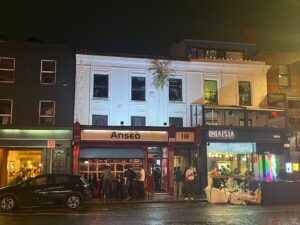 On our perambulations around Dublin this week, we visit what feels like a proper dive bar…that is, assuming proper dive bars all have a few good local taps and a killer playlist. If so, then Anseo is, indeed, in that category. But its slightly-scrubby-yet-cheerful interior doesn’t entirely hide the building’s history: this is a mid-18th century house, complete with a few extant interior features, that’s been repurposed as a pub since the mid-19th century. If you
 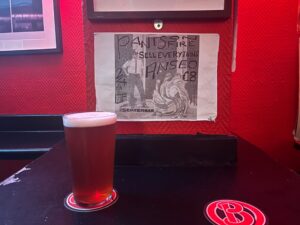 You are most likely to be visiting Anseo to catch a gig from an up-and-coming band or artist, or, perhaps, seeing some stand-up comedy upstairs; you may also be doing a
 As regular readers know, we are always on the lookout for
  While the ‘since 1793’ date is a little shaky, given the current building’s construction
  So, ghosts aside, what is the pub like? Well…most definitely not creepy. If anything, it’s a bit too polished to feel at all like a liminal space. There are several very different sections of the pub with their own character, but none are especially dark or gloomy. The front is much more ‘pubby’ and the rear more of a restaurant or hotel bar vibe (the many large TV screens are part of what gives that impression), though it’s worth knowing that the back bar is where the sole local-craft-beer representative is; there’s a Rye River tap if you know where to look. Indeed, the food was very good – a step up from a lot of pub food, though the enormous portions are perhaps created more for tourists than locals. There’s also the usual Guinness – and Murphy’s – plus some Warsteiner.
 There’s a covered outdoor space too, more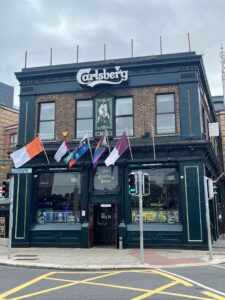
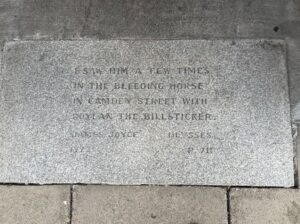 The Bleeding Horse gets the usual James Joyce namecheck in Ulysses, complete with a stone at the door to remind the visitor, but I’m personally more interested in the
  A 17th century ale-house would have been somewhat akin to our modern ‘wet pub’ (yes, it’s a terrible phrase), with drink on offer, but little else, while an inn would have offered accommodation as well as refreshment. And although ‘public houses’
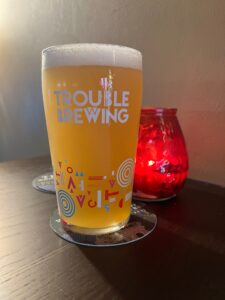
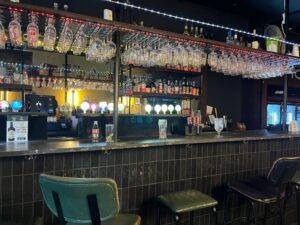 Now rebranded Teach Tábhairne Ag Teacht (so, ‘pub’ or ‘pub coming,’ perhaps? My Irish is all second-hand, based on my smaller child’s school assignments), the changes are less cosmetic and more fundamental to the feel of the place. In its former guise, the pub had been renovated under two years ago, and it considerably brightening things up, giving it a bit of glamour, while still feeling quite ‘pubby.’ Now, though, it just feels dark, as if some of the still-newish improvements have been scuffed or sullied up a bit. The real problem, however, is what’s happened to the beer. While obviously no longer a Galway Bay pub, it’s gone from having an always-interesting selection of house and guest beers to a tiny handful of craft taps. On the plus side, the Ambush was in good shape, but I need to be in the mood for The White Hag’s Púca – a fruited sour, for the uninitiated – and only one other (rotating?) tap, at the moment from Galway Hooker. For our purposes here, I’m not counting the Beavertown Neck Oil as any kind of upgrade to the lineup, the rest of which is all
 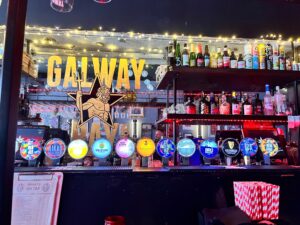 Well, that wasn’t the only reason, though it was a bit too on brand for that…but I digress.
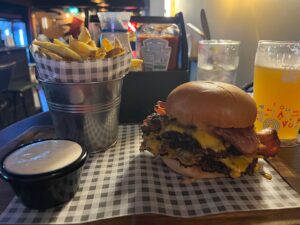 While not (as far as I am aware) directly related to Galway Bay Brewing, there is a short-term-but-still around nod toward Galway and a ‘temporary’ rebranding as Gaillimh Abú (essentially, ‘up Galway!’) for the All-Ireland football and camogie finals (including discounts for Galway supporters in their jerseys – a few jerseys on the wall being the main evidence of this inside), but as someone who lives near Croke Park and sees all the GAA fans stream past my house on their way into the stadium*, trekking to and from this part of town before a game can be a non-trivial task. Without getting into the nuances of which pubs are ‘homes’ to which county supporters – a much bigger topic – it’s fair to say a lot of the pre-gaming happens closer to the action – I tend to simply avoid my local pubs on game days because of the crowds.
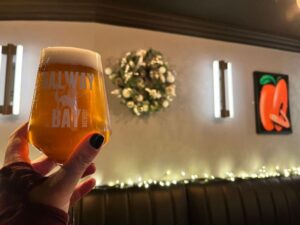 Crowds, though, were noticeably absent on my visit to Teach Tábhairne, while other spots on the same street had a lively presence. On one hand, it gave more opportunity to chat to the wonderful staff. On the other, however, this is no longer a pub to settle in to try a variety of different things. It’s more of a spot to get a quick bit to eat and a glass or a pint on the way somewhere else, instead of a destination in its own right.