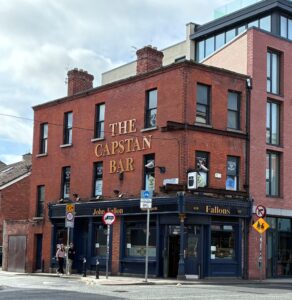
 Despite having ‘The Capstan Bar‘ spelled out in large letters on the side of the building, this pub is more commonly knowns as Fallon’s to locals. And while the ‘est 1619’ sign may hang above the entrance, the pub’s website is a bit more circumspect, only referencing ‘a legacy dating back to 1619,’ which, while still overstating the case, is made much less of a selling point than the entirely fakety-fake date The Brazen Head likes to claim, only a short walk away.
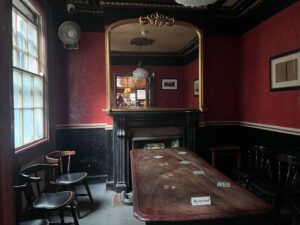
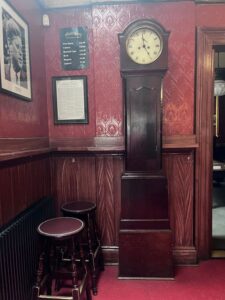
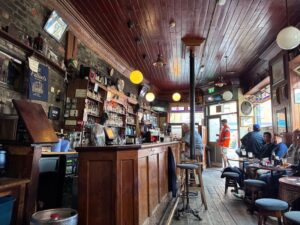 Indeed, nothing in Fallon’s looks much older than the early 20th century, which makes sense – it was rebuilt in 1911 after a fire, and most records seem to indicate a firm late 19th century foundation for a pub on this specific spot, though there is evidence of the re-use of elements of earlier buildings. But this area – bordering The Liberties and The Coombe – had dozens of pubs (or, before that, pub-like businesses) in centuries prior, and ‘The Capstan‘ is a reference to the sailors and dock workers who would have frequented the area in the past. It’s sported the ‘Fallon’s‘ name since the 1970s; there is likely an entire thesis to be written on how and when Irish pubs have names more or less permanently assigned to them, and how those do still continue to evolve today. In short, there’s plenty of history in this area.
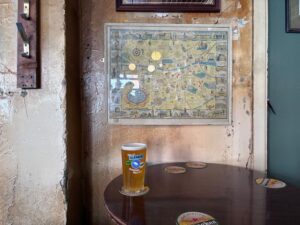 But back to Fallon’s – it’s wonderfully quiet (or, at least, was on our afternoon visit), and the snug at the front might be a good addition to our Best Pubs for Books roundup. There was a fairly even split between locals and well-behaved tourists on our visit, all enjoying the wooden floorboards and ceiling that offer something of an organic feel. There are independent locals beers on at reasonable prices, though most of the tourists were in for their ‘best Guinness,’ as per usual.
But if we were to recommend a ‘best way to enjoy’ Fallon’s, we’d suggest a browse at Marrowbone Books and a quiet pint after with your ‘new find’ – there’s no better way to spend a Sunday afternoon.
Where: 129 The Coombe, The Liberties, Dublin 8, D08 NP52
Access from the city centre: Buses 13, 14, 15, 15A, 15B, 16, 27, 68, 77A, 122, 150, 151 or 18ish minute walk
Food: Toasties, soup
Sport: Occasional big events
TVs: Small screen
Music: Blissfully quiet
Family-friendliness: A few kids having a weekend afternoon Coke & crisps on our visit
Pub-crawl-ability: High – The Fourth Corner, Lucky’s, Lynott’s, Molly’s Bar, Drop Dead Twice, The Liberty Belle, Dudley’s, The Lord Edward, Arthur’s, Guinness Open Gate Brewery, Swift, The Brazen Head, The Christchurch…and many more
Local sites of note: St. Patrick’s Cathedral, Marsh’s Library, Chester Beatty, Dublin Castle, St Audoen’s Church, Christ Church Cathedral, Dublinia, Guinness Storehouse
Haunted: There’s plenty of good archaeology under these streets…
Other notes: While the toilets are on the main floor, they are tight squeezes
Socials: Instagram, Facebook, TikTok
 This week’s Dublin pub is another frequently-requested one that we’ve put off visiting for far too long, and we were quite wrong to delay. Although previously labouring under the misapprehension that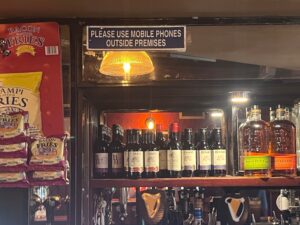
 As regular readers will know, we collect ghostlore of all stripes, and frequently complain that we simply don’t get enough of it around Dublin pubs, so finding
  We tend to avoid bigger crowds when out and about (and, frankly, we like to be home early – sleep is important!), but we recently made an exception to stop into
  It certainly leans more ‘gastro’ than ‘pub,’ but the overarching feeling about the place is ‘
 And while it may feel a bit less spontaneous than your typical
  And while we are usually visiting
  Part music venue, part dive bar,
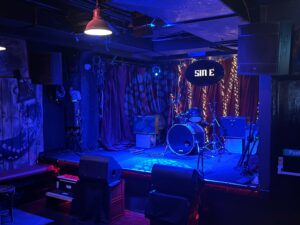
 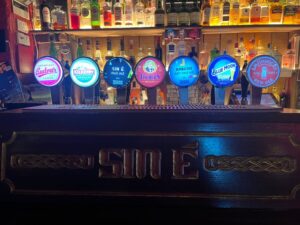 And while the formal stage at the back of the main floor makes it feel more venue than pub, it’s got a rather respectable beer lineup, including its own beer from Trouble, as well as the more-common Ambush. There is also a Kilkenny tap – it’s no longer so lesser-spotted around Dublin – and the other usual suspects.
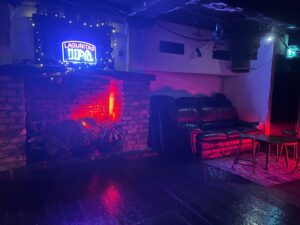 But downstairs, where there are more seating and stage options, is where there’s a bit of a slightly eerie historic atmosphere; the stone walls, low lighting, cool temperature and quiet (during the afternoon – not, of course, so much at night during a gig) do suggest, even if it’s ever-so-slightly, The Unseen. We couldn’t find any good ghost stories, but they do put on some good Halloween shows, so it’s worth keeping an eye out for that, even if the folklore isn’t forthcoming.
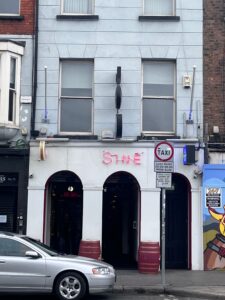 While you’re unlikely to find us out and about at one of their 2 am events, in a city with an ever-shrinking number of creative and arts spaces for both emerging and established artists, it’s handy to have one with a real personality; being in a 300-ish year old building is a bonus.
 We’ve been rather remiss in not getting to Kavanagh’s in
  We took a break from the partying to relax indoors with some pints – the sun was ‘too bright’ for the youngest in our party – and to have a general nosey around the pub. Inside it’s every inch the Victorian/Edwardian pub – there are public and lounge bars that have separate outdoor entrances, but that are also connected inside via the stained-glass-adorned doors that (also) lead to the toilets – you’ll just need confidence walking through that you know where you’re going.
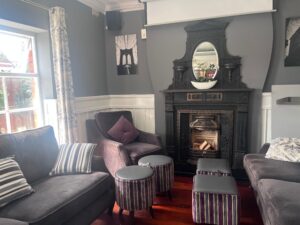 But as imposing as it looks outside, it’s pleasantly warren-like inside – there’s a semi-snug near the front on one side, and a variety of cosy spots on the other, including a tiled inset that seems to have appeared from the 1930s, while the rest of the bar remained in about 1901 (the date on the façade outside does
  There aren’t any independent beer offerings (and no, Beavertown certainly doesn’t count nowadays), but it is possible to do the Big Three Stouts here for those who enjoy doing their blind Guinness/Murphy’s/Beamish tasting; we tend to prefer Beamish of the three, but all were in excellent shape. As an aside on the ‘comparing stouts’ point, this is a handy area for it –
 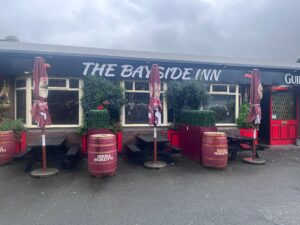 It’s true we have a tendency to stick to pubs that are north of the Liffey, but we rarely venture out into the true suburbs – we are usually still within reasonable walking distance of Dublin city centre. This week, however, we take a longish bus ride out to the wilds of Kilbarrack to visit The Bayside Inn.
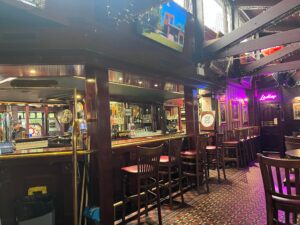 Indeed, The Bayside Inn is so ‘of this place’ that it sits in the car park in the shopping centre, next to the church – all of a thoroughly 1970s vintage. One gets the feeling that not much has changed in the internal décor since the doors opened in 1974 (per the painted gold letters on the half-glass doors. Some fairy lights have been added to the open rafters, and a taxidermied bear is observing proceedings from above, but beyond the TV screens, we doubt that much has been altered. It might not be a perfect time capsule from the 1970s, but it’s also not terribly far off. And while there may be very slight visual and architectural similarities to this particular vintage of ‘estate pubs’ on the Neighbouring Island, the feeling is still very much ‘neighbourhood Dublin pub’ – it doesn’t have a ‘locals only’ vibe, even if it does have plenty of regulars (which can, of course, be said of many estate pubs in Britain, even if that’s not the popular reputation).
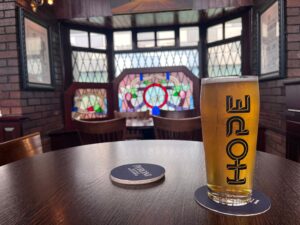 And some things have changed with the times; there is good support for local independent beer here, with fresh selections from Hope, brewed under 2 km away at Howth Junction, on tap. Yes, there’s Guinness and all the other usual options, but it’s nice to see smaller local businesses giving each other a helping hand. We confess we’ve only made it up here when we’ve been visiting local friends (or doing a spot of cat-sitting), but we’ve always felt very welcome here, even as only occasional drop-ins.
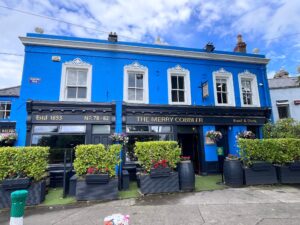 This week, we make a trip not only south of the Liffey, but nearly into the heart of Dublin 4, with a visit to
 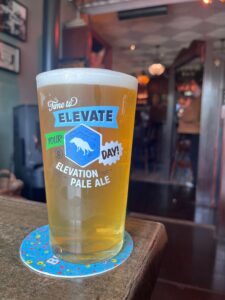 It’s very much a neighbourhood spot, welcoming local families, game day regulars and guests – you can even stay in the pub. And while its renovation of the past decade means it’s got a bit more polished wood and stained glass than many of its counterparts on the other side of the river, it never feels snobby. There are some lovely snugs – again, more stained glass – and various different spaces to spread out around this large pub. Local independent beers are well-represented (from Trouble and Wicklow Wolf on this most recent visit, though we’ve also seen Hope in the past), but this is another spot where the stout enthusiast can do the full Guinness–Beamish–Murphy’s taste test.
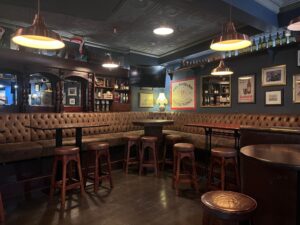 We will eventually do a ‘Best Pubs for the Aviva’ roundup to complement our ‘
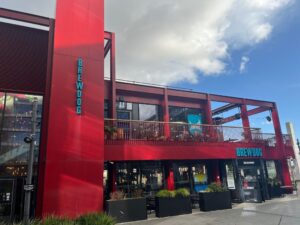 BrewDog is, once again, back
 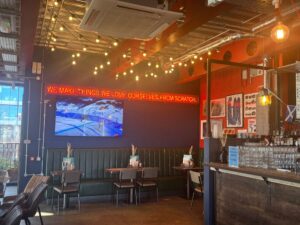 Inside, the look is straight out of
 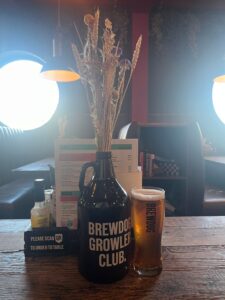 Nowadays, we are rarely in this part of town, and if we were looking for pre-show drinks, we’d be more likely to hit up
 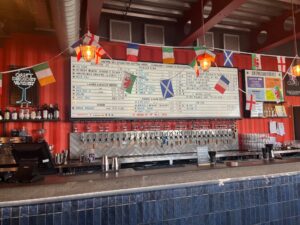 We have no insights into ‘what will happen’ with BrewDog’s uncertain future (though it’s difficult to imagine a space of this size continuing without global private equity money). In our ideal world, this would continue as an independent tap room and community space with the same staff, but we also know that’s highly unlikely. It’s also possible a buyer will swoop in and continue running BrewDog’s portfolio as-is (for good and ill), but as of this writing, it’s all guesswork.
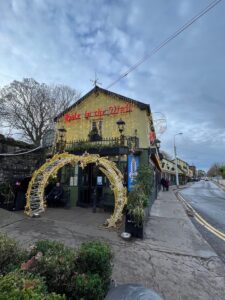 Staying on
 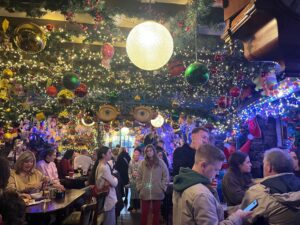 Inside, it can be absolutely packed at this time of year, both with decorations (similar to
 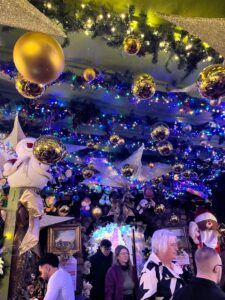 But The Hole in the Wall is a pub for life, not just for Christmas – there are also running and cycling clubs based here, and it’s a handy spot if you happen to be on this side of the Phoenix Park (though you’d have
 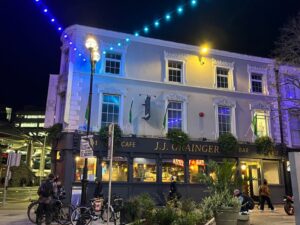 Dublin – indeed, Ireland – is not over-endowed with glorious (or even ‘fine’) train stations. Having recently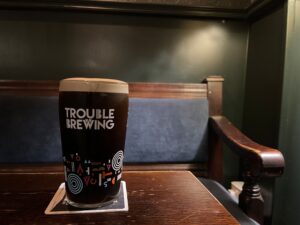
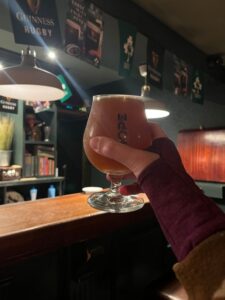 The staff were also friendly and welcoming – how many pubs would put on the ‘Airwolf’ theme when asked to do so (not, it must be said, by us, but we did enjoy it)? And while it’s true that this part of Dublin still has a bit of a ‘reputation,’ something we’ve discussed in our entry on