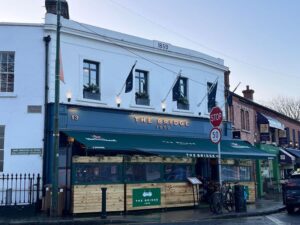
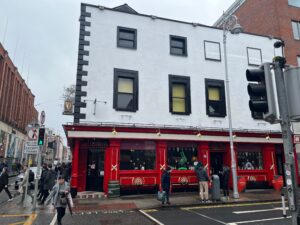
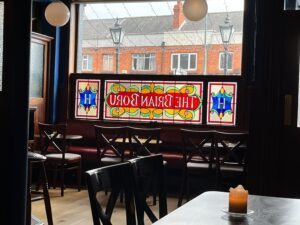
 While it may seem that we rarely venture south of the Liffey (true, really), we recently had occasion to be down in our old Ballsbridge stomping grounds, and so returned to The Bridge 1859 for the first time in quite a while. We last stopped into this beautifully-decorated pub just before we moved out of the area, and enjoyed a last fresh Pilsner Urquell from their gravity tank. This time, the welcome was just as warm, the décor on point, the food excellent – but the beer selection nowadays is, as the kids say, mid. Let’s review.
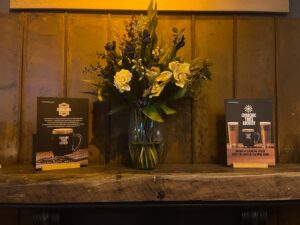 There has been much local discussion surrounding the launch of Changing Times beer; it’s something of a collaborative effort among a number of pubs, including some heavy hitters like The Long Hall, Doheny & Nesbitt and The Palace Bar. While it’s proclaimed as ‘brewed in Glasnevin,’ it doesn’t seem to have a single pub north of the river serving it, at least, so far. The beers offered so far are a lager (clearly for the Heineken fan), a hazy pale ale (not really sure who it’s aimed at beyond; it feels a bit unkind to say ‘people who don’t like beer,’ but…) and now, a stout. The stout is by far the most drinkable of the three on offer so far, and seems to be the only one served at any kind of ‘discount,’ but again, it’s essentially like a very light Murphy’s versus having much of its own character. It’s one thing to launch a new beer brand, but it’s another to launch it with the kind of ‘meh’ beers that gave early-2000s investor-driven ‘craft beer’ a bad name, especially in a market with comparatively little of the real thing, as it were.
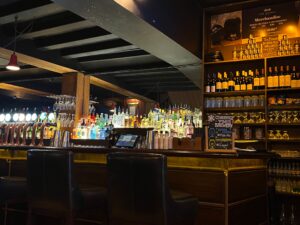 And that may be all well and good for many customers, but these new brews haven’t (mostly) muscled out the usual macro suspects; it’s the ‘good’ beers that have been jettisoned to make space, including – really a loss here – the Pilsner Urquell. Removed from The Bridge’s menu now are Rye River Upstream Pale Ale, Warsteiner lager and, er, Madri. The Madri may be no great loss, but the others are keenly felt (especially if, say, A Friend were really looking forward to a Pilsner Urquell, sighed to make do with a Warsteiner and then realised that the only drinkable lager was Carlsberg). To add insult to injury, the hand-painted panel all about Pilsner Urquell has been partially, but not entirely, covered by a television. Ouch.
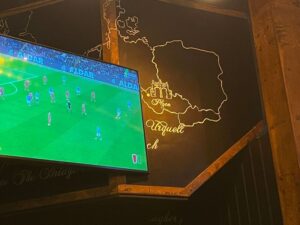
And I get it – it’s a pub that largely caters to a rugby crowd (albeit one of all ages – kids are quite welcome here), and so it’s not aiming to be a hangout for people who like good beer, but it did once have good beer, and now it…doesn’t. It feels rather like so many higher-end Irish restaurants do: there may be a well-curated wine list, amazing food and nothing but the most boring macro beers possible. And that’s not to say they should dump Guinness or Carlsberg – I like both Guinness and Carlsberg – but I’d much rather have the option to support other independent local breweries – at least before, there was the Rye River option. And with so many duplicate macro taps, there were plenty of spots to shuffle things around a bit instead of losing the others. Perhaps the most telling part of the visit was that our waitress didn’t even know what Pilsner Urquell was, even though it was painted behind her on the wall. As James once sang, ‘…if I hadn’t seen such riches, I could live with being poor.’
That said, it’s entirely possible that other publicans will see this effort and, perhaps, give another local beer a shot on one of their taps – we’ve previously discussed Four Provinces appearing at The Tolka House – and there are still plenty of usual suspects there for everyone – so let’s hope that some are a bit more open to experimentation. The prices are more likely to suit everyone involved, too.
But again, there are many positives at The Bridge 1859: excellent food, a lovely atmosphere, very cosy seating and attentive service. Shame about the beer – pour one out for the Pilsner Urquell…
Where: 13 Ballsbridge Terrace, Dublin 4, D04 C7K6
Access from the city centre: Buses 4, 7, 7A, 38A, 39, 39A, 70, 120, E1, E2; 35ish minute walk
Food: Gastropub offerings & snacks
Sport: Rugby, football, the usual big event sports
TVs: All around the pub
Music: Veered toward the MOR
Family-friendliness: More-interesting-than-most kids’ menu
Pub-crawl-ability: Low – The Horse Show House is down the road, and a further walk to The Old Spot and The Bath Pub
Local sites of note: RDS, Aviva Stadium, various embassies, National Print Museum
Haunted: Something something Pilsner Urquell…
Other notes: Beautifully-appointed rooms upstairs for private events
Socials: Facebook, Instagram
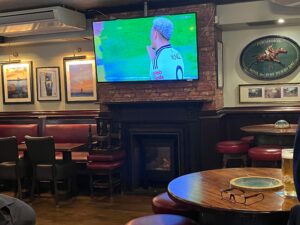
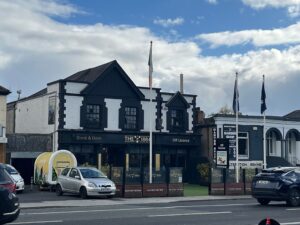 The 1884 is so called after the year that the GAA was founded, and it is very much a sporty pub. And while the GAA is the most-represented sporting genre on the walls and in the niches, there’s plenty of (association) football on the screens as well, especially on a weekend visit such as our recent one.
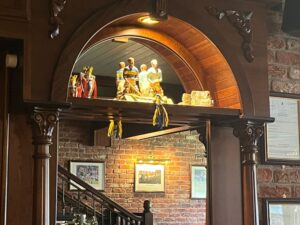 And like many pubs in the more suburban parts of Dublin, it’s absolutely enormous inside – indeed, somewhat barn-like. But it’s all very tidy, and there’s plenty of space to spread out. There are much-appreciated coat hooks under the bar, which really should be standard everywhere, but here we are. Only a few years ago, this pub was known as Grainger’s, and it had, well, a reputation, and although there are a few reminders of that era, it seemed generally ‘neighbourhood-pubby’ on our visit.
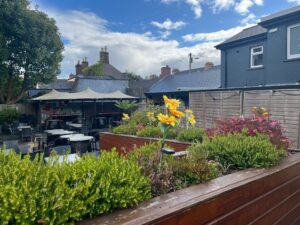 And while the beer selection is mostly the usual Guinness-and-Heineken-and-so-so-much-Rockshore (despite being listed as a stockist of Hope, brewed just a bit further north), there is also the lesser-spotted Kilkenny, which has been popping up here and there of late, and it’s a nice alternative. The real hidden gem of The 1884, though, is the enormous beer garden out back. Yes, there is a Pavement Pints option out front, right on the busy road, but if you head to the back, there is a wide range of covered and uncovered seating options.
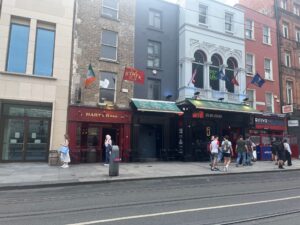 Cask ale, as we have often complained, is something of a rarity in Ireland. While there are a few more pubs with a regular cask offering up in Belfast, here in Dublin, it is simply not a regular feature in most pubs. Happily, though, a tipoff from a reader (cheers, Ciaran!) alerted us to a beer engine in regular use at Harty’s Bar. Naturally, we dropped everything to go investigate.
 One reason this pub had not been on our radar is that, appearances notwithstanding, it’s a fairly new establishment (but also not; bear with us) – until about 18 months ago, it was the Dingle Whiskey Bar. But like its neighbour,
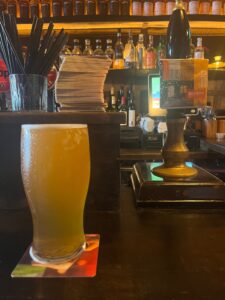
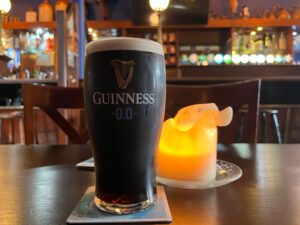
 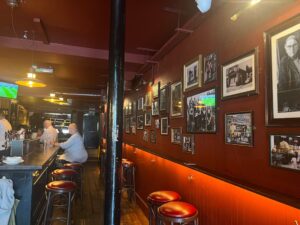 While it doesn’t have the selection of beers next door in Tapped, with its enormous bar, for a small space, it has a good lineup of some of the more standard Porterhouse beers – the Plain Porter, Yippy IPA and Red – as well as Trouble’s Ambush. There’s also Guinness, of course, and Beamish. But as you know, we were here for the cask option: this week, it was
 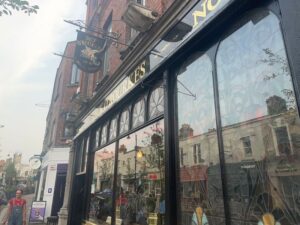 We know that we tend to be biased toward pubs on the north side of the Liffey, but this week, we travel (relatively) far into south Dublin – all the way to Blackrock and . Once a quiet fishing village with a sideline in
 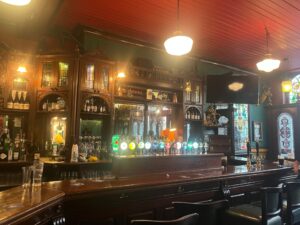 And while the
 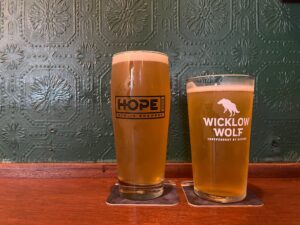 There are some lovely little snugs and the pub also has a bit of a nautical bent – the seafront is right here, after all – but it’s very welcoming to all; the standard Guinness (and Beamish!) is on offer, and there is good support for independent offerings like Hope and Wicklow Wolf, as well as
 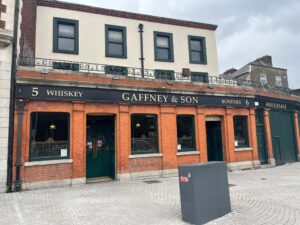 Dublin excels at
 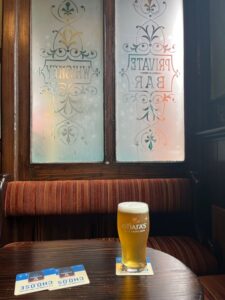 There’s a warm welcome, and not one, but two local independent beers offerings: Hope and O’Hara’s are always well-kept here. The bar serves two separate sections, each with their own respective snugs and other seating, and there are lots of little corners to duck into if you’re looking for that quiet solo pint. And it’s interesting to note that while everything you see now is very much hearkening back to the late 19th century, this is, in fact, an older pub – the original building(s) is/are Georgian, and its first license
 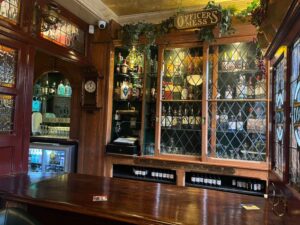 Our one knock on many Old Man Pubs is that they rarely offer any beers beyond the usual Guinness and Heineken (though to be fair, it’s usually an excellent Guinness from scrupulously clean tap lines), but as mentioned above, at Gaffney’s, there is good support for other choices, plus Beamish as another stout option. This beer selection, combined with the attractive interior, might just make it the perfect Dublin Old Man Pub.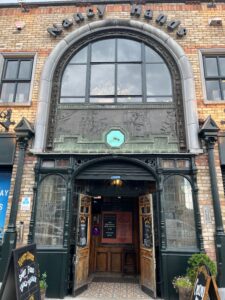
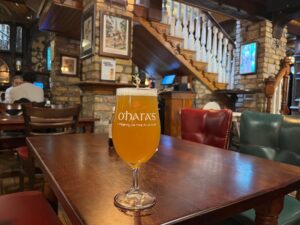 The staircase formerly connected floors in Trinity College, and the beer garden out back can even be heated when necessary (though as with so many of the more interior-feeling beer gardens in Dublin, it can tend toward feeling very smoky). All told, it feels very ‘pubby,’ but what strikes me is the very noticeable vibe shift when the tour groups leave. It took a few visits to realise that it wasn’t just the freeing up of part of the pub that made the real difference; rather, it was the music. When the groups are in, the music is not just trad (there is, after all, plenty of good trad out there), but full-on diddly-eye trad – the sort of music that might have been featured on an American PBS station 40+ years ago. But once they go, there’s a break – either no music, or a change to something a bit more current. Perhaps it’s coincidence, but it’s something we’ve noticed on multiple visits – and it’s no bad thing!
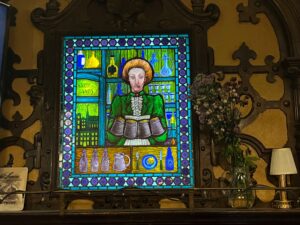 Now, this is not to say that some of the more touristy pubs are doing their customers a disservice in any way; to the contrary, they are doing a great job of catering to multiple demographics, and more power to them. And Nancy Hands also does a great job of supporting local writers –
  Sometimes, it really is all about The Socials.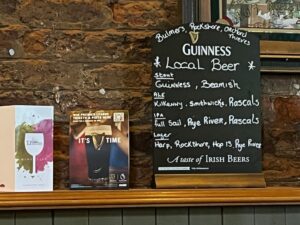
 Last week, we asked whether
  The pub has been here since the 1850s, and in the Hedigan family since 1904, and you can’t miss their name in neon, either. Of course, like so many pubs along this route, it’s name-checked in Ulysses, and has a useful write-up
  Well, there have been proposals to
  We are back this week with a ‘request pub’ – one that’s much further north than our more common north-of-the-Liffey-but-still-pretty-central stomping grounds. We’re heading out of Dublin City proper to Howth; it’s an easy trip on the DART, but a bit of a pain if, for example, you needed Dublin Bus to deposit you to a nearby spot at a predetermined time. Dublin Bus is not always especially good at the concept of ‘on time’ (but it’s pretty great on ghost buses), so the journey in this general direction involved more taxis than I typically take in a 6-month period, but we got there in the end. Our (eventual) destination was
  I’d recently had an exchange on the socials lamenting the lack of railway station bars in Ireland, and while we have nothing here quite like the small-but-mighty
 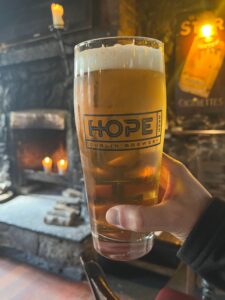 We enjoyed excellent food and service when we stopped in, which isn’t necessarily a given in some pubs mid-week in the middle of the afternoon (hardly a fruitful time for most), so it was much appreciated. There is outdoor seating as well around both ends of the pub, but we kept to the more dimly-lit interior on a lovely sunny afternoon. Having offspring who actively avoid the sun may be odd to others, but hey, at least their vampiric ways are preventing long-term sun damage, and the pub interior really is lovely, all stone and dark wood.
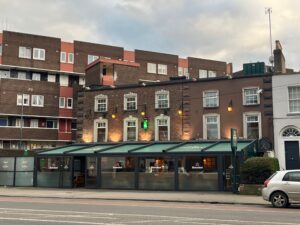 A proper ‘Pubs of Croke Park’ roundup is long overdue, and with so many events on this summer, we may as well finally start working on that. While we’ve already covered a few handy ones like
 It’s very much a ‘locals’ pub most of the time, but a welcoming one; I’ve had out-of-town guests wind up there and have great chats with the barstaff. No frills, but no pretention, either. If you are looking to pre-game before an event at Croke Park, it’s hard to be better-placed for an easy walk in to the stadium. And, of course, the pub’s name