Weirdo Guide to Dublin Pubs: The Hairy Lemon

Upstairs at The Hairy Lemon: old signs and bikesWe’ve not always been fair to The Hairy Lemon.

In truth, until recently, we’d only visited it in a tourist capacity, long before moving to Dublin (see also: The Long Hall), and as a result, it felt less like a ‘local’ pub and more like one that catered purely to those here on brief trips. And while it certainly has a booming tourist trade, a more recent stop by made us realise that there’s more going on here, and that it can be well worth a drop in when we’re at Craft Central anyway. Uh, we are not infrequently ‘at Craft Central anyway’ – but that’s another story.

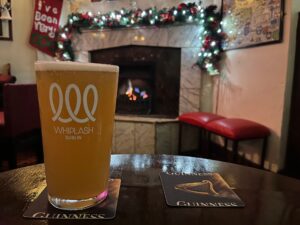
The bar at The Hairy LemonThe first point in its favour – for us, anyway – is its support for local independent beer: there are multiple Rye River taps, and they are all kept in excellent shape. Indeed, it has always felt like many of the more tourist-friendly pubs are missing a trick by not highlighting other Irish beers. Yes, people want their Guinness, but plenty of tourists also want to follow it up with something else that seems unique or exclusive to the area. The Hairy Lemon does a fine job of offering both experiences, and not just a token ‘extra’ tap – there’s not just a variety of styles from Rye River, but also Murphy’s and the rarer Murphy’s Red.

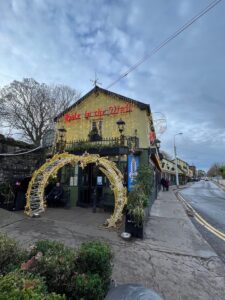
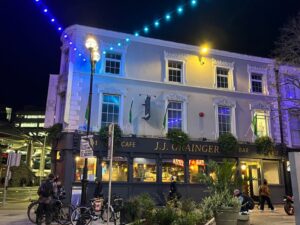
A terrible picture of the exterior of The Hairy LemonWhile it’s true that when in this general direction we are more often to be found at Caribou, with other beer options in a more ‘bar’ vibe setting, tourists (or anyone else) looking for more of an traditional pub feel are well catered to at The Hairy Lemon. And it comes by its ‘Irish pub’ bona fides honestly: the current all-yellow paintjob may be more recent, but it’s been a pub since at least the mid-19th century. The Hairy Lemon is named for one of Dublin’s many ‘characters’ – like Bang Bang (commemorated in both café and pub form, with Bang Bang in Phibsborough and Dudley’s in The Liberties), The Hairy Lemon was ‘known’ around town, and while he had no specific connection to the pub, it honours his memory, and, more broadly, that of the other long-gone Dublin ‘characters.’

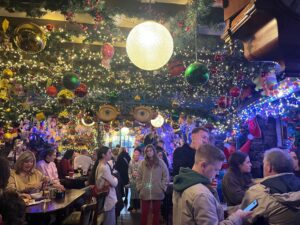
And if on your visit to The Hairy Lemon it seems packed full of tourists at lunchtime, a wander upstairs can be blissfully calm; there are several pleasant nooks and crannies in which to sit with a quiet solo pint, even here in the middle of town.

Where: 41-42 Stephen Street Lower, Dublin 2
Access from the city centre: You are there
Food: Breakfast, pub grub, tourist faves, kids’ menu
Sport: Essentially all of them
TVs: Many all around the pub
Music: Fairly MOR tunes, at least on a weekday afternoon; live music in the evenings
Family-friendliness: Always a fair few kids during the day and evening and plenty of food for them
Pub-crawl-ability: High – Neary’s, Caribou, Bar Rua, The Long Hall, Grogan's, Peter's Pub, Sinnot's Bar and more are all nearby
Local sites of note: Gaiety Theatre, Craft Central (we said what we said), Little Museum of Dublin, George's Street Arcade, St Stephen's Green, Grafton Street
Haunted: An appalling lack of good ghost stories
Other notes: Still looks more or less the same as it did when The Commitments was filmed here
Socials: Instagram, Facebook

Weirdo Guide to Dublin Pubs: Neary’s

The famous hand-held lamps at Neary'sWhile The Flowing Tide serves as Northside Dublin’s premier theatrical pub, with its close associations with the neighbouring Abbey Theatre (and its short walk to The Gate), Neary’s takes on that role on the Southside for the Gaiety Theatre. Alas, though, one of the finest theatrical tales about Neary’s seems to be a bit of a myth. In Donal Fallon’s excellent new book, The Dublin Pub: A Social and Cultural History (a must-have for any pub nerd), the story of Alan Devlin storming offstage at the Gaiety during a production of HMS Pinafore* and demanding drink at Neary’s is only true…in part.

A glass of O'Hara's upstairs at Neary's

In reality, it seems Devlin only made it as far as Sinnott’s, just steps away…so while Neary’s have claimed the (delightful) story, it’s actually more accurately one that belongs to the whole street. But Neary’s has featured in other legendary activities, too – Nell McCafferty famously led a protest here in 1974, demanding that women be served pints (THINK OF THE CHILDREN), and a version of the story makes its way into the book as well; the good news is that once again, there’s more than a grain of truth here.

The main bar at Neary'sAnd it is, perhaps, fitting that Neary’s is a pub that attracts this kind of lore; its beautifully-maintained interior hearkens back to the 1880s – well, at least in the main bar downstairs – while upstairs, it’s a slightly more updated restaurant feel, but still elegantly understated. The working gas lamps and dumbwaiter inside are well-known historical features, but the literally hand-held lamps outside are iconic.
Despite its history and location next to the Gaiety, it doesn’t feel quite as ‘theatrical’ as The Flowing Tide – the subject of its own chapter in The Dublin Pub – but it wears its literary heritage very well indeed. Pints-wise (and yes, anyone of age can have those pints now), O’Hara’s is the independent option, with the usual Guinness as well. Our small quibble would be the unused/possibly not real hand pumps – regular readers know we feel A Way about cask ale – but they do seem part of the furniture here.

Of course, we’ve only scratched the surface here; Dublin’s pubs have so many fantastical stories – some more fact-based than others – and we cannot recommend Donal’s book highly enough. Consider this your call to action to pick up a copy if you have not already done so!

It’s an ideal read for an afternoon with a book and a solo pint.

Where: 1 Chatham Street
Access from the city centre: You are in it
Food: Sandwiches (toasties and more), salads, oysters
Sport: Not here
TVs: None at all
Music: Quiet jazz upstairs in the Lounge, occasional live sets
Family-friendliness: A surprisingly large number of babies and toddlers mid-afternoon
Pub-crawl-ability: High – The Hairy Lemon, Caribou, Bar Rua, The Long Hall, Grogan's, Peter's Pub, Sinnott's Bar and more are all within a short wander
Local sites of note: Gaiety Theatre, Craft Central (absolutely a landmark for the beer nerds), Little Museum of Dublin, George's Street Arcade, St Stephen's Green, Grafton Street
Haunted: There’s a story of a deceased punter…so perhaps!
Other notes: While there is the dreaded (by us) Changing Times Hazy IPA, there’s still the aforementioned O’Hara’s
Socials: Instagram, Facebook


*FWIW, your fair scribe has been in many productions of HMS Pinafore, and could easily step into essentially any role if need be, as long as some transposing down were a possibility for anything higher than mezzo. But Sir Joseph? Yes, could absolutely do it. And so could our sisters and our cousins and our aunts…

Weirdo Guide to Dublin Pubs: Anseo

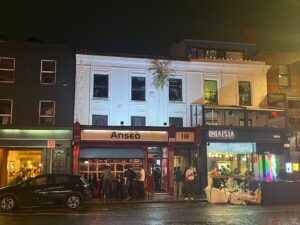
Exterior of Anseo by nightOn our perambulations around Dublin this week, we visit what feels like a proper dive bar…that is, assuming proper dive bars all have a few good local taps and a killer playlist. If so, then Anseo is, indeed, in that category. But its slightly-scrubby-yet-cheerful interior doesn’t entirely hide the building’s history: this is a mid-18th century house, complete with a few extant interior features, that’s been repurposed as a pub since the mid-19th century. If you know where to look, you can spot some of that legacy hiding in plain sight.
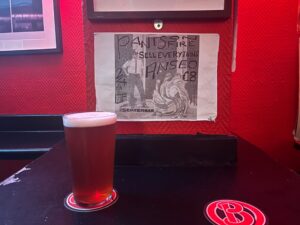
A Scraggy Bay at AnseoYou are most likely to be visiting Anseo to catch a gig from an up-and-coming band or artist, or, perhaps, seeing some stand-up comedy upstairs; you may also be doing a Camden Street pub crawl before a show elsewhere along the way, or as a standalone activity. But regardless of what’s brought you here, the dark red walls and fairy lights make for quite a pleasant spot for a Scraggy Bay or an Ambush (or, perhaps, Beamish, if you prefer), and while the music isn’t especially quiet, it’s well-chosen. There are books and café tables along the wall opposite the bar, and while at first glance it may not feel like an ‘Irish pub’ to the visitor, on closer inspection, it’s hard to find it anything but.

Inside a relatively-crowded Anseo

First, of course, the name: ‘Anseo‘ is Irish for ‘here,’ and a quick scan of the posters all over the pub for bands and comedians turns of plenty of local colour, in both the Irish and English languages. The books, too, have a good mix of hyperlocal as well as global political and literary interest, and, again, there is good support for local Irish independent beer. The tea, naturally, is Barry’s. In short, despite some universal dive bar superficialities, this bar is as ‘Irish’ as they come.

You won’t find the glass-and-dark-wood snugs and plush seats of an Old Man Pub here, but you will find locals and visitors of all (adult) ages, enjoying what feels like a real community spot. In short, it’s a perfect spot for a pre-gig pint, whether that show is just up the stairs or a quick hop down the road.

Where: 18 Camden Street Lower
Access from the city centre: Buses 9, 14, 15, 16, 27, 56A, 65B, 77A, 83, 140, 151, 15-ish minute walk
Food: N/A
Sport: Occasional rugby
TVs: A few screens here and there
Music: Bands, DJs, comedy
Family-friendliness: Not for the kids
Pub-crawl-ability: High – The Bleeding Horse, Devitt’s, Teach Tábhairne Ag Teach, The Camden, The Portobello Bar, Whelan’s, Ryan’s of Camden Street…and the local ‘Spoon’s, Keavan’s Port
Local sites of note: Iveagh Gardens, St Stephen’s Green, National Concert Hall, St Kevin’s Park, Grand Canal
Haunted: Maybe! There’s plenty of ‘atmosphere’
Other notes: Main-floor toilets
Socials: Instagram

Weirdo Guide to Dublin Pubs: The Portobello Bar

Outside The Portobello PubAs regular readers know, we are always on the lookout for a pub with a good ghost story, whether it’s October or, really, any time. The pub in question we’re visiting this week doesn’t feel particularly spooky, but it does have an interesting history to go along with the ghost story, even if they aren’t perfectly well-connected. Without further ado, we make our way to The Portobello Bar.

The front bar at The Portobello BarWhile the ‘since 1793’ date is a little shaky, given the current building’s construction in the 1870s, it seems entirely plausible that there was, indeed, an inn or pub around here earlier. The Grand Canal’s proximity – just across a heavily-used road – supports the possibility of an earlier date, and it’s also what supplies our ghost story. Construction began on the Grand Canal in the late 18th century, and it was a key piece of infrastructure in the 19th and early 20th centuries. Our ghost – a ‘vengeful’ or ‘drunken’ lock-keeper (take your pick/why not both?) – is alleged to originate in the middle of the 19th century, forever haunting the lock just outside the pub. He’s even meant to be responsible for multiple deaths, appearing as a shapeshifting light-into-human-figure. As an aside, we don’t get enough shapeshifting ghostlore any more – there used to be a proud tradition of spooks turning into hay bales or cows and horses, and that seems to have vanished in modern ‘it happened to me stories’ – someone should get on that. But we digress…

But there was a very real tragedy just opposite the pub’s location in 1861, when a horse-drawn omnibus went off the nearby bridge into the canal, killing all the passengers as well as both horses. While ‘some’ attributed the accident to the spectral lock-keeper, it would be an interesting exercise to trace back the origin of that part of the story, especially since the current pub (or, at least, most of it) would have been built or re-built at least a good few years after the accident.

Back bar at The Portobello BarSo, ghosts aside, what is the pub like? Well…most definitely not creepy. If anything, it’s a bit too polished to feel at all like a liminal space. There are several very different sections of the pub with their own character, but none are especially dark or gloomy. The front is much more ‘pubby’ and the rear more of a restaurant or hotel bar vibe (the many large TV screens are part of what gives that impression), though it’s worth knowing that the back bar is where the sole local-craft-beer representative is; there’s a Rye River tap if you know where to look. Indeed, the food was very good – a step up from a lot of pub food, though the enormous portions are perhaps created more for tourists than locals. There’s also the usual Guinness – and Murphy’s – plus some Warsteiner.

Covered Pavement Pints area at The Portobello BarThere’s a covered outdoor space too, more Pavement Pints than beer garden, given the amount of traffic nearby, but you do get a view of the canal lock and the (haunted?) bridge. And even if you’re not into the ghostly folklore, The Portobello Bar does have other legitimate historical claims: back when it was called Davy’s, it was an important site during the Easter Rising in 1916, and that history is very much remembered in this pub.
We may not have seen the vengeful lock-keeper at The Portobello Bar, but we did have a good burger and pint. We’ll keep trying to find some good haunted Dublin pub stories

Where: 33 South Richmond St, Dublin, IE D02 CF40
Access from the city centre: Buses 9, 15, 15A, 15B, 16, 83, 83A, 140; 25-ish minute walk
Food: Elevated pub grub, carvery, weekend brunch
Sport: All the sport, football especially
TVs: So many large screens in the back that it can feel a bit sports-bar-y
Music: DJs and live music at weekends
Family-friendliness: At the usual times
Pub-crawl-ability: High – Camden street is full of pubs and bars like The Bleeding Horse, Devitt’s, Teach Tábhairne Ag Teach, The Camden, Whelan’s, Anseo, Ryan’s of Camden Street…and the local ‘Spoon’s, Keavan’s Port
Local sites of note: Iveagh Gardens, St Stephen’s Green, National Concert Hall, St Kevin’s Park, Grand Canal
Haunted: Is it the lock-keeper? The tram passengers? The horses? Everything to play for here
Other notes: Main-floor toilets, though no specific disabled toilet
Socials: Facebook, Instagram

Weirdo Guide to Dublin Pubs: The Bernard Shaw

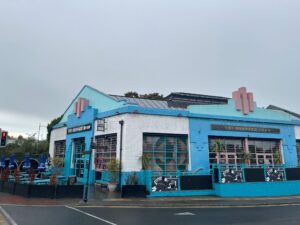
Exterior of The Bernard Shaw

Despite walking past it multiple times a day most days, we’ve not had occasion to call in to The Bernard Shaw recently. This part of Dublin – the Phibsborough/Glasnevin border – is already well-served with great pubs like The Bald Eagle just across the canal, more food-forward spots like The Botanic around the corner, and world-renowned spots like The Gravediggers within a short walk. And so despite having an interesting selection of food vendors in its adjoining Eatyard, The Bernard Shaw is rarely top of mind as a spot for a quiet (or loud) drink or a family meal. True, they do have a drag brunch that we’ve heard is good fun, but the in-house food and drinks are always mentioned as not quite up to par for the neighbourhood, especially for the price.

And perhaps the fact that it doesn’t feel  much like, well, a pub is part of the issue; in its previous incarnation in Rathmines, it had a variety of spaces and programming options, but it still felt very much like a (rather scruffy) pub. However, that closed in 2019, and it moved to the current spot, a former Porterhouse location, not terribly long after. But much about the interior feels very much temporary: colourful cardboard dividers, upstairs and downstairs spaces closed off at some times and not others, and even the Eatyard itself is sometimes table service, sometimes walk-up, and it’s never entirely clear which is which or what is on offer when.

Inside one end of The Bernard ShawWhile it does have a theoretically reasonably interesting drinks lineup, like its fellow Bodytonic-managed bar, The Back Page, sometimes quite a few taps are not in working order – but again, other times, it’s all fine. But if all is present and correct, there are usually multiple Kinnegar choices, an Outcider tap and the more usual Guinness and Beamish, plus cocktails. Between the two locations, we tend to go to The Back Page more often: it has a more distinct identity as a spot for watching soccer and some more obscure sport, and the pizza is consistently pretty decent.
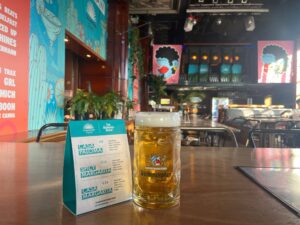
A beer on a table at The Bernard ShawIt is, of course, entirely possible that it’s simply aiming for a younger/cooler demographic, which is fair enough…though it does beg the question as to why there’s a mural of Peter Fonda on one side of the building…it’s not something that resonates with GenXers like us…are the younger Millennials into Easy Rider? We’ve been told it’s a ‘no’ from Gen Z: ‘…it’s no Taxi Driver.’
But we actually *do* quite enjoy some of the events that take place at The Bernard Shaw – there are handy record fairs, local community art markets and so on that are great to have in the neighbourhood; we may just go elsewhere for that ‘pub’ experience after. But with so many to choose from in this area, there’s absolutely something for everyone.

Where: Cross Guns Bridge, Dublin, D09 XW44
Access from the city centre: Buses 9, 40, 46A, 83, 140; Luas Green Line; 30ish minute walk
Food: Breakfast, lunch, dumplings, hot dogs
Sport: Big events shown: Rugby, football, etc
TVs: Scattered around
Music: The hipster music vibes are strong
Family-friendliness: Children around at the usual times
Pub-crawl-ability: High. Multiple options nearby: The Bald Eagle, The Brian Boru, Doyle's Corner, The Boh, The Hut and The Back Page in one direction, with The Botanic, The Gravediggers and The Tolka House in the other…
Local sites of note: Royal Canal Greenway, National Botanic Gardens, Glasnevin Cemetery, Mountjoy Prison, Dalymount Park
Haunted: Oddly, no ghosts obviously associated with the nearby Cross Guns Bridge
Other notes: Toilets are very much not accessible
Socials: Facebook, Instagram

Weirdo Guide to Dublin Pubs: The Long Hall

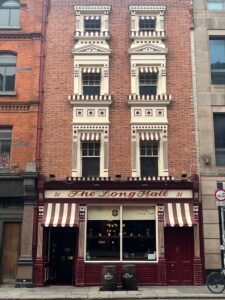
Exterior of The Long HallIn our effort to fill in the blanks when we see you getting lost in our search results, we’re aiming to visit some of the more common pubs on the tourist trail here and there, now that the bulk of the summer holidaymakers have gone home. Indeed, this week’s pub is one we’ve only ever previously visited in that capacity, years before moving to Dublin: The Long Hall.
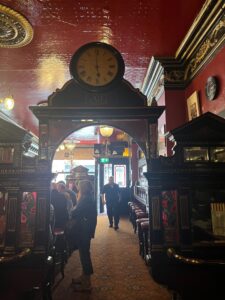
The clock at The Long HallVisiting again with more ‘local’ eyes does make you notice different things, but the fundamentals remain the same: the beautifully-maintained – and, in this case, likely genuinely world-famous – exterior of the pub is unmistakable, with its signature red-and-off-white stripes. Inside, it’s the kind of high Victorian décor that is more commonly a pastiche these days, but The Long Hall comes by it honestly: its last real renovation was in the 1880s. And while the deep reds and dark woods are common to many other local Dublin pubs of this vintage – a subject to which we’ll return – there are unique features here, including the much-loved clock, added in 1912.
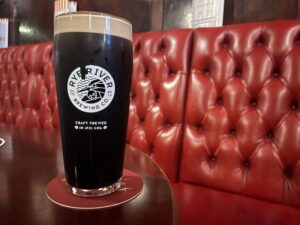
For us, it ticks more boxes from a musical history perspective – the Phil Lynott and Bruce Springsteen bona fides are legit, though arguably, it’s more the interior (and the central location) that put The Long Hall firmly on the tourist trail. Thinking back to that first visit and why it came so highly recommended, a few memories resurfaced: 1) ‘the quality of the pint of Guinness;’ 2) the very-Victorian feel; and 3) the availability of other local beers – at the time, from McGargle’s (now better-known as Rye River).

A pint of Rye River stout at The Long Hall

Coming back to the first point as a local, there is no objectively ‘best’ pint of Guinness. Yes, there are places where it seems especially appropriate, like The Gravediggers (or, obviously, the Open Gate), but given that fresh Guinness and clean tap lines are essentially a given everywhere, that ‘best’ pint is purely down to atmosphere.  (I said what I said). As a visitor, The Long Hall is certainly a fine spot for one – but it’s also a nice place to enjoy that Rye River pint. Fortunately, that’s still an option – too many other pubs have turfed out long-standing local independent options for their pricey Changing Times beer (looking at you, The Bridge 1859), and while the stout is not bad, there are still too many tap lines here taken up with some of the other Changing Times options – though again, happily there are still other choices available here.

But it’s the middle theme – the Victorian interior – that feels different with more-experienced eyes. If you’re only briefly in town and don’t have the time to explore, The Long Hall is a great spot to see this kind of pub. But once you’ve lived in Dublin for a while – or even just spent significant time here – you’ll know that there are other pubs that are just as ornate, or even more so, but without the tourist crowds (and prices). The Hut and Gaffney’s are just two examples, but especially for the cut-glass enthusiast, we’d suggest visiting those as well for comparison. Both also retain more of their Old Man Pub atmosphere which the tourist crowd dilutes somewhat at The Long Hall, though we’d very much emphasize that this isn’t a tourists-only joint like The Brazen Head, just that there are a lot of them, much of the time, and that’s fine.

So, it’s less of a case of ‘you can never go home again,’ but rather, once a place becomes your home, you find your own regular spots that are likely not those you visited on a quick trip. These days, when I’m in this part of town, Caribou is my usual go-to (after stopping off at Craft Central to re-stock the home fridge, of course), but there’s still plenty to enjoy at The Long Hall, whether you are a local or a newbie. The experience may be a different one with less-fresh eyes, but that’s no bad thing…

Where: 51 South Great George’s Street, Dublin 2, D02 DV74
Access from the city centre: 5ish minute walk or right in it, depending on your point of view
Food: N/A
Sport: N/A
TVs: N/A
Music: Quite a generic playlist
Family-friendliness: Children not allowed – a rare-for-Dublin hard pass for the kids
Pub-crawl-ability: High – Grogan’s, The Hairy Lemon, Caribou, Peter’s Pub, Sinnot’s Bar and Bar Rua are all within stumbling distance, with many more beyond
Local sites of note: George's Street Arcade, Gaiety Theatre, St Stephen's Green, Dublin Castle, Chester Beatty, Craft Central (IYKYK)
Haunted: Again, a truly lamentable lack of ghostlore for a pub of this age
Other notes: There’s air con! And main-floor toilets, but not always in the most agreeable condition
Socials: Facebook, Instagram

Weirdo Guide to Dublin Pubs: Harty’s Bar

The streetscape at Harty's Bar, with Tapped to its rightCask ale, as we have often complained, is something of a rarity in Ireland. While there are a few more pubs with a regular cask offering up in Belfast, here in Dublin, it is simply not a regular feature in most pubs. Happily, though, a tipoff from a reader (cheers, Ciaran!) alerted us to a beer engine in regular use at Harty’s Bar. Naturally, we dropped everything to go investigate.

A pint of Brehon Blonde next to the hand pumpOne reason this pub had not been on our radar is that, appearances notwithstanding, it’s a fairly new establishment (but also not; bear with us) – until about 18 months ago, it was the Dingle Whiskey Bar. But like its neighbour, Tapped, with whom it shares a kitchen and menu, it has had a variety of identities, both before and throughout its tenure in the broader Porterhouse portfolio. Now described as ‘a country pub in the big smoke,’ its most recent refit leans into low light, dark woods and deep reds. It also seems smaller than during its whiskey days, but we’re not certain whether this is an accurate feeling or some kind of MR James ‘Number 13’ effect happening. In any event, there’s still plenty of Dingle Whiskey, also part of the Porterhouse group, as well as others.

A view into Harty's BarWhile it doesn’t have the selection of beers next door in Tapped, with its enormous bar, for a small space, it has a good lineup of some of the more standard Porterhouse beers – the Plain Porter, Yippy IPA and Red – as well as Trouble’s Ambush. There’s also Guinness, of course, and Beamish. But as you know, we were here for the cask option: this week, it was Brehon Brewhouse’s Blonde. And cask is a great way to serve this beer; it helps bring out a bit more of the biscuity malts that are a bit harder to notice when it’s poured from a can. The bartender shared that it’s more commonly the Stony Grey IPA on the hand pump, so it was a nice changeup.

And although you can still count the pubs in Dublin with working beer engines on one hand, it’s nice to know that we are at least back to having at least 1-2 cask options available on nearly any day of the week…if you know where to go.

And to that end, we’ve added a new category: cask.

Enjoy!

Where: 44 Nassau St, Dublin, D02 YY44
Access from the city centre: Right there
Food: Pub grub and beyond
Sport: Football, GAA…the usual big sports
TVs: Small screen near the bar
Music: No music on our visit; sport instead
Family-friendliness: Depends on the time of day, but there is food
Pub-crawl-ability: High – Tapped is next door, and McDaid’s, Bowes, O’Neill’s, Cassidy's, Mulligans, The Palace Bar, JR Mahon’s, The Oval Bar, Porterhouse Temple Bar, Kennedy's and many, many more are all within a very short stroll
Local sites of note: Trinity College, National Library of Ireland, National Museum of Ireland (Archaeology and The Dead Zoo), Leinster House, Irish Whiskey Museum, NATIONAL WAX MUSEUM
Haunted: Perhaps the revamp was too recent for ghosts?
Other notes: There’s even working air con…more rare still than cask ale
Socials: Instagram

Weirdo Guide to Dublin Pubs: Jack O’Rourke’s

A quick sideways glance at Jack O'Rourke's from the outsideWe know that we tend to be biased toward pubs on the north side of the Liffey, but this week, we travel (relatively) far into south Dublin – all the way to Blackrock and . Once a quiet fishing village with a sideline in early modern highway robbery, Blackrock is now one of the bougier parts of suburban Dublin, as evidenced by it now being labelled Blackrock Village (with a capital ‘V’). But given its handy coastal location and useful DART station, it’s no surprise that this area, with its mix of historic homes and railway development, would have become spot for both day-trippers and locals.

The bar at Jack O'Rourke'sAnd while the town Village centre is not huge, it has an excellent off-license in the form of Blackrock Cellar, as well as some other independent stores, though there is not a vast array of pubs. Happily, though Jack O’Rourke’s serves many constituencies very well indeed. The pub is beautifully decorated in a broadly high Victorian style, with plenty of stained glass and deep colours. Indeed, records suggest that there has been an inn or pub here since at least the 18th century, which fits well with tales of highwaymen and shipwrecks that are tied to Blackrock. But Jack O’Rourke’s is very much a family pub, now in its fourth generation under the care of the O’Rourkes, and its design and décor fit well with the ‘1897’ date on the façade.

Pints of Hope and Wicklow Wolf at Jack O'Rourke'sThere are some lovely little snugs and the pub also has a bit of a nautical bent – the seafront is right here, after all – but it’s very welcoming to all; the standard Guinness (and Beamish!) is on offer, and there is good support for independent offerings like Hope and Wicklow Wolf, as well as Legacy Cider – craft ciders are especially hard to find across Ireland, so this is a nice bonus for fans of the apple.

All told, it’s a real gem of a pub: something of a combination of the best aspects of an Old Man Pub, paired with a welcoming atmosphere for well-behaved children, good food, local beer and excellent service. Well worth the trip on the Dart!

Where: 15 Main St, Blackrock, Dublin, A94 HN66
Access from the city centre: Buses 4, 7, 7A, DART
Food: Pub grub
Sport: Major events shown
TVs: Scattered around the pub
Music: Fairly MOR soundtrack in the background, never too loud for easy conversation
Family-friendliness: Children welcome
Pub-crawl-ability: Low – local spots like The Blackrock and The Wicked Wolf are nearby, but it’s a small selection without travel further afield
Local sites of note: Frascati Shopping Centre, Blackrock Park, Blackrock Historic Baths
Haunted: There were two massive shipwrecks just off the coast here…
Other notes: Rock Shandy was invented here – iconic!
Socials: N/A

Weirdo Guide to Dublin Pubs: The Cobblestone

Outside The CobblestoneOur featured Dublin pub this week is one that has been in the ‘much requested’ queue for some time. While we had to make it a flying visit, we finally got to The Cobblestone.

In many ways, it’s difficult to think of a more iconic Dublin pub. News of its possible closure or truncation for yet another identikit hotel caused protests, including a mock funeral, and the pub was given extensive press coverage during that period of threat, including a wonderful documentary. And although The Cobblestone today is best known as ‘the’ spot for trad music, it was not always the case.

A pint of Four Provinces Piper inside The CobblestoneUntil a little over a decade ago, both before and after Smithfield’s redevelopment from a market into a mix of housing and offices, this was an early house, open at 7 am for the market traders and, later, shift workers. And as the number of early houses has continued to dwindle – even Slattery’s doesn’t always open so early these days – The Cobblestone has evolved as well. Music slowly became an integral part of the offering, along with things like Irish language and dance classes, meetups and the like. From what had been a few sessions a week, live music is now a daily part of festivities, but it’s still a very casual-yet-regular one most of the time.

It’s less a case of booking for a gig and more one of wandering into see who’s playing, and it’s one of the few options for the tourist who only has a few hours and wants to get in a bit of daytime trad at the weekend, as there’s nearly always something on. But unlike some pubs, this is by no means just a tourist hotspot – it’s a much-loved part of the community.

The crowd at The Cobblestone, early on a weekend afternoonAnd while it can be a bit rough around the edges, likely needing a few coats of paint and some repairs here and there (not to mention having slightly-infamous toilets), that’s part of the charm. Yes, it would be nice if some of the derelict buildings surrounding The Cobblestone were used for, say, housing, but it really does feel like a landmark as-is.

It’s not the pub you’d go to for food or for a long chat over a pint (though there is, of course, plenty of Guinness, plus some representation from Four Provinces) – there’s music to be heard here, albeit not in the coach-tour-with Irish-dancing-and-a-meal sense – but for trad and a true mix of locals and mostly-respectful tourists, it’s a go-to.

Where: 77 King St N, Smithfield, Dublin, D07 TP22
Access from the city centre: Buses 37, 39, 39A, 70, 83, 83A, Red Line Luas, Green Line Luas, 30ish minute walk
Food: None
Sport: No
TVs: Not here
Music: This is your spot for trad (though see also Piper’s Corner)
Family-friendliness: Kids are welcome earlier in the evenings to listen to music, if that’s their jam; it will nearly always be crowded
Pub-crawl-ability: High – Delaney’s is right there, Bonobo is a short walk, with, The Belfry, The Glimmer ManThe Barber’s Bar, Walsh’s, Hynes’ Bar and L Mulligan, Grocer all in Stoneybatter – with another 10 minutes in the other direction to Underdog or down Capel Street
Local sites of note: Lighthouse Cinema, Collins Barracks, Four Courts, St Michan’s Church
Haunted: Does ‘haunting’ music count?
Other notes: The ‘could be tidier’ can sometimes apply to taplines, too – you may want to check a friend’s pint first
Socials: Instagram, Facebook

Weirdo Guide to Dublin Pubs: Frank Ryan’s

Outside Frank Ryan'sHave we found Dublin’s darkest pub?

While the exterior of Frank Ryan’s Pub is bright-ish candy colours of pink and yellow, the interior is more None More Black. The smell of incense and the nod toward illumination with a string of fairy lights adds to the student-squat vibe, but this is a student squat for someone who takes their music collection (vinyl, presumably) quite seriously.

And while the music is a shared interest with Fidelity, just across the street, the look and feel could not be a greater contrast: Fidelity is all large windows and polished metal, while Frank Ryan’s is more found furniture and inherited memorabilia everywhere. And yet, there is a significant crossover in the Venn diagram of pub-goers: it is not at all unusual to see people shuttling between the two pubs. No doubt some of this is down to the pizza offering at Frank Ryan’s – the food at Fidelity Studio is wonderful, but it can seem more of a ‘special occasion’ meal (indeed, you may need a reservation), while the pizza can be a more affordable handy mid-session snack or meal.

Pizza and a Carlsberg at Frank Ryan's

While we wouldn’t quite put the pizza in the same class as MeMa’s or The Morris Bar (not to mention Rascals, which is next-level), it is tasty. The beer offerings are a bit more pedestrian than some in the area – the O’Hara’s and Hopefully taps seemed a bit tired – but the Carlsberg was quite lively, and there’s always the Guinness. Again, though, there’s a world of options just across the street at Fidelity on the beer front, and with such proximity, there’s no need to choose just the one type of establishment. And sometimes, there’s nothing better to pair with a pizza than a fresh Carlsberg.

There is some light to be found toward the front and back of Frank Ryan’s (if you’re the sort of person who prefers to see your pizza or pint), and there’s even a seating area at the rear that splits the difference between a small beer garden and a Pavement Pints setup; we’ll allow arguments either way.

Inside Frank Ryan's: barrels, tables and fairy lightsAll told, though, the vibe at Frank Ryan’s is extremely laid-back, and it can be a respite from the sun on a hot day; it’s not the sort of pub that’s going to be to everyone’s taste, but with so many in the broader Smithfield/Stoneybatter area, there’s a pub for nearly everyone.

Just remember to have the light on your phone handy here.

Where: 5 Queen St, Smithfield, Dublin 7, D07 T227
Access from the city centre: Buses C1, C2, C3, C4, 37, 39, 39A, 70, 83, 83A, Red Line Luas, 20ish minute walk
Food: Pizza
Sport: Not likely
TVs: If they are there, they are hidden in the dark
Music: Eclectic mix of jazz, Afrobeats and other good stuff; live jazz on Thursdays
Family-friendliness: Saw a few mid-size small folk getting pizza
Pub-crawl-ability: High – Fidelity is right across the street, and Bonobo, The Cobblestone, Delaney’s, The Belfry, The Brazen Head, The Barber’s Bar, Walsh’s, Hynes’ Bar and L Mulligan, Grocer are all within a few minutes' walk – and that's just getting started
Local sites of note: Lighthouse Cinema, Collins Barracks, Four Courts, St Michan’s Church, St Audoen’s Church, Christ Church Cathedral, Dublinia, Guinness Storehouse
Haunted: I mean, it *is* dark…
Other notes: The women’s toilet is hidden behind the ‘gents’ sign and neither seems especially accessible; dogs welcome
Socials: Instagram, Facebook