
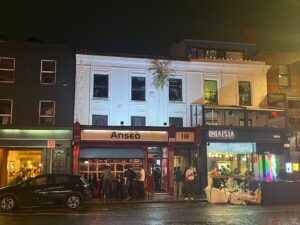
 On our perambulations around Dublin this week, we visit what feels like a proper dive bar…that is, assuming proper dive bars all have a few good local taps and a killer playlist. If so, then Anseo is, indeed, in that category. But its slightly-scrubby-yet-cheerful interior doesn’t entirely hide the building’s history: this is a mid-18th century house, complete with a few extant interior features, that’s been repurposed as a pub since the mid-19th century. If you know where to look, you can spot some of that legacy hiding in plain sight.
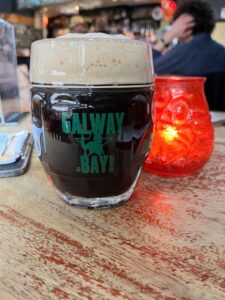
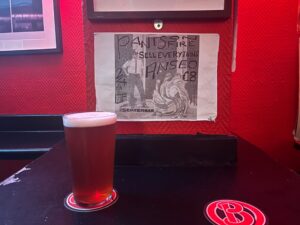 You are most likely to be visiting Anseo to catch a gig from an up-and-coming band or artist, or, perhaps, seeing some stand-up comedy upstairs; you may also be doing a Camden Street pub crawl before a show elsewhere along the way, or as a standalone activity. But regardless of what’s brought you here, the dark red walls and fairy lights make for quite a pleasant spot for a Scraggy Bay or an Ambush (or, perhaps, Beamish, if you prefer), and while the music isn’t especially quiet, it’s well-chosen. There are books and café tables along the wall opposite the bar, and while at first glance it may not feel like an ‘Irish pub’ to the visitor, on closer inspection, it’s hard to find it anything but.

First, of course, the name: ‘Anseo‘ is Irish for ‘here,’ and a quick scan of the posters all over the pub for bands and comedians turns of plenty of local colour, in both the Irish and English languages. The books, too, have a good mix of hyperlocal as well as global political and literary interest, and, again, there is good support for local Irish independent beer. The tea, naturally, is Barry’s. In short, despite some universal dive bar superficialities, this bar is as ‘Irish’ as they come.
You won’t find the glass-and-dark-wood snugs and plush seats of an Old Man Pub here, but you will find locals and visitors of all (adult) ages, enjoying what feels like a real community spot. In short, it’s a perfect spot for a pre-gig pint, whether that show is just up the stairs or a quick hop down the road.
Where: 18 Camden Street Lower
Access from the city centre: Buses 9, 14, 15, 16, 27, 56A, 65B, 77A, 83, 140, 151, 15-ish minute walk
Food: N/A
Sport: Occasional rugby
TVs: A few screens here and there
Music: Bands, DJs, comedy
Family-friendliness: Not for the kids
Pub-crawl-ability: High – The Bleeding Horse, Devitt’s, Teach Tábhairne Ag Teach, The Camden, The Portobello Bar, Whelan’s, Ryan’s of Camden Street…and the local ‘Spoon’s, Keavan’s Port
Local sites of note: Iveagh Gardens, St Stephen’s Green, National Concert Hall, St Kevin’s Park, Grand Canal
Haunted: Maybe! There’s plenty of ‘atmosphere’
Other notes: Main-floor toilets
Socials: Instagram
 As regular readers know, we are always on the lookout for
  While the ‘since 1793’ date is a little shaky, given the current building’s construction
  So, ghosts aside, what is the pub like? Well…most definitely not creepy. If anything, it’s a bit too polished to feel at all like a liminal space. There are several very different sections of the pub with their own character, but none are especially dark or gloomy. The front is much more ‘pubby’ and the rear more of a restaurant or hotel bar vibe (the many large TV screens are part of what gives that impression), though it’s worth knowing that the back bar is where the sole local-craft-beer representative is; there’s a Rye River tap if you know where to look. Indeed, the food was very good – a step up from a lot of pub food, though the enormous portions are perhaps created more for tourists than locals. There’s also the usual Guinness – and Murphy’s – plus some Warsteiner.
 There’s a covered outdoor space too, more
 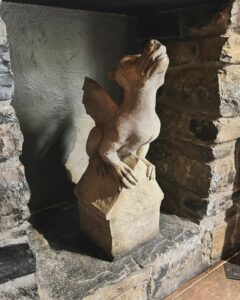 Perhaps surprisingly to some (certainly, to us), Dublin pubs do not contain a wealth of ghostlore. There are, of course,
 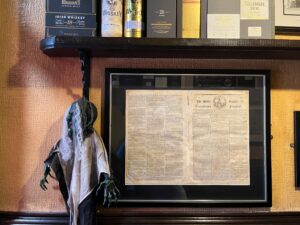 We’re less inclined toward the flashy, big-name haunting at
 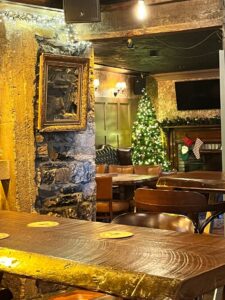 But we also want to shine the spectral spotlight on another pub whose apparitional associations are often overlooked:
 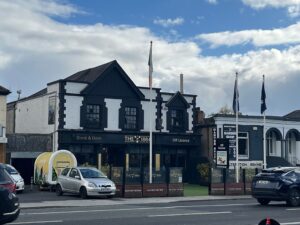 The 1884 is so called after
 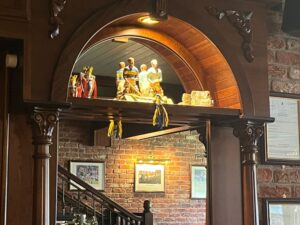 And like many pubs in the more suburban parts of Dublin, it’s absolutely enormous inside – indeed, somewhat barn-like. But it’s all very tidy, and there’s plenty of space to spread out. There are much-appreciated coat hooks under the bar, which really should be standard everywhere, but here we are. Only a few years ago, this pub was known as Grainger’s, and it had, well, a
 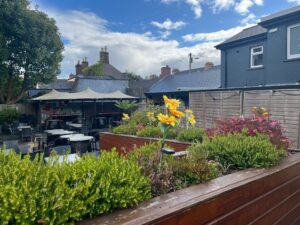 And while the beer selection is mostly the usual Guinness-and-Heineken-and-so-so-much-Rockshore (despite being listed as a stockist of Hope, brewed just a bit further north), there is also the lesser-spotted Kilkenny, which has been popping up here and there of late, and it’s a nice alternative. The real hidden gem of The 1884, though, is the enormous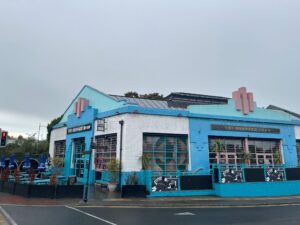
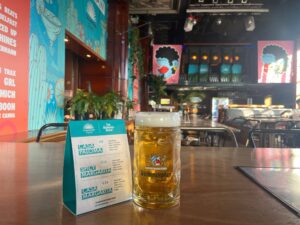
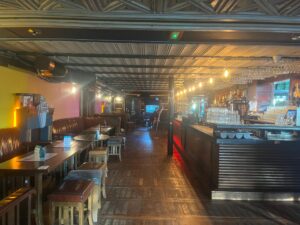 While it does have a theoretically reasonably interesting drinks lineup, like its fellow Bodytonic-managed bar,
  It is, of course, entirely possible that it’s simply aiming for a younger/cooler demographic, which is fair enough…though it does beg the question as to why there’s a mural of Peter Fonda on one side of the building…it’s not something that resonates with GenXers like us…are the younger Millennials into Easy Rider? We’ve been told it’s a ‘no’ from Gen Z: ‘…it’s no Taxi Driver.’
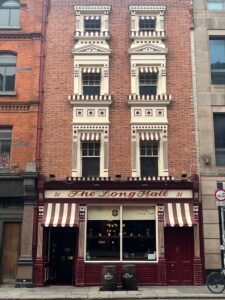 In our effort to fill in the blanks when we see you getting lost in our search results, we’re aiming to visit some of the more common pubs on the tourist trail here and there, now that the bulk of the summer holidaymakers have gone home. Indeed, this week’s pub is one we’ve only ever previously visited in that capacity, years before moving to Dublin: The Long Hall.
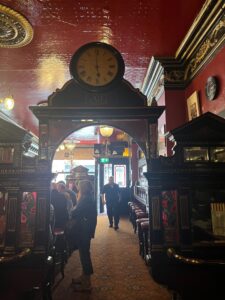 Visiting again with more ‘local’ eyes does make you notice different things, but the fundamentals remain the same: the beautifully-maintained – and, in this case, likely genuinely world-famous – exterior of the pub is unmistakable, with its signature red-and-off-white stripes. Inside, it’s the kind of high Victorian décor that is more commonly a pastiche these days, but The Long Hall comes by it honestly: its last real renovation was in the 1880s. And while the deep reds and dark woods are common to many other local Dublin pubs of this vintage – a subject to which we’ll return – there are unique features here, including the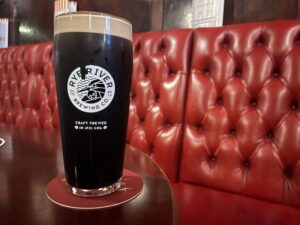
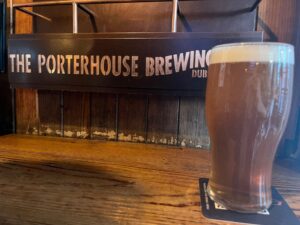 Yes, it's cheating a bit, since we just visited a new-to-us cask ale spot last week in
  The Black Sheep
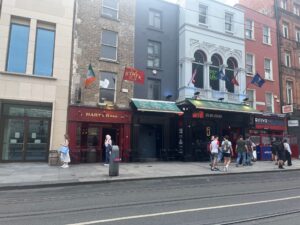 Cask ale, as we have often complained, is something of a rarity in Ireland. While there are a few more pubs with a regular cask offering up in Belfast, here in Dublin, it is simply not a regular feature in most pubs. Happily, though, a tipoff from a reader (cheers, Ciaran!) alerted us to a beer engine in regular use at Harty’s Bar. Naturally, we dropped everything to go investigate.
 One reason this pub had not been on our radar is that, appearances notwithstanding, it’s a fairly new establishment (but also not; bear with us) – until about 18 months ago, it was the Dingle Whiskey Bar. But like its neighbour,
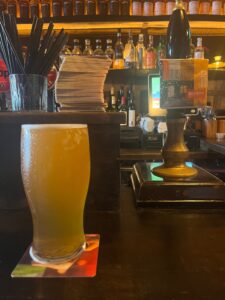
 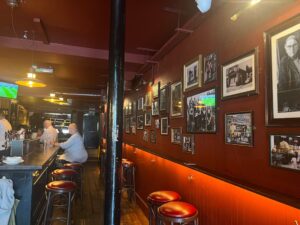 While it doesn’t have the selection of beers next door in Tapped, with its enormous bar, for a small space, it has a good lineup of some of the more standard Porterhouse beers – the Plain Porter, Yippy IPA and Red – as well as Trouble’s Ambush. There’s also Guinness, of course, and Beamish. But as you know, we were here for the cask option: this week, it was
 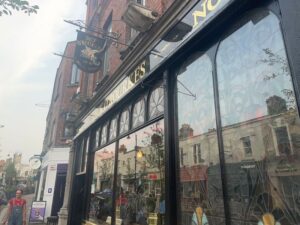 We know that we tend to be biased toward pubs on the north side of the Liffey, but this week, we travel (relatively) far into south Dublin – all the way to Blackrock and . Once a quiet fishing village with a sideline in
 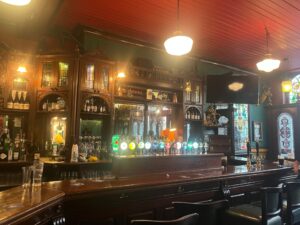 And while the
 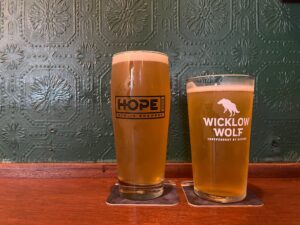 There are some lovely little snugs and the pub also has a bit of a nautical bent – the seafront is right here, after all – but it’s very welcoming to all; the standard Guinness (and Beamish!) is on offer, and there is good support for independent offerings like Hope and Wicklow Wolf, as well as
 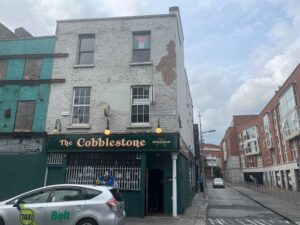 Our featured Dublin pub this week is one that has been in the ‘much requested’ queue for some time. While we had to make it a flying visit, we finally got to
 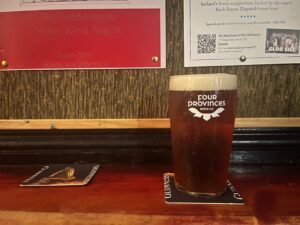 Until a little over a decade ago,
 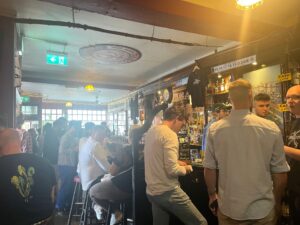 And while it can be a bit rough around the edges, likely needing a few coats of paint and some repairs here and there (not to mention having slightly-infamous toilets), that’s part of the charm. Yes, it would be nice if some of the derelict buildings surrounding The Cobblestone were used for, say, housing, but it really does feel like a landmark as-is.