 We’ve not always been fair to The Hairy Lemon.
In truth, until recently, we’d only visited it in a tourist capacity, long before moving to Dublin (see also: The Long Hall), and as a result, it felt less like a ‘local’ pub and more like one that catered purely to those here on brief trips. And while it certainly has a booming tourist trade, a more recent stop by made us realise that there’s more going on here, and that it can be well worth a drop in when we’re at Craft Central anyway. Uh, we are not infrequently ‘at Craft Central anyway’ – but that’s another story.
 The first point in its favour – for us, anyway – is its support for local independent beer: there are multiple Rye River taps, and they are all kept in excellent shape. Indeed, it has always felt like many of the more tourist-friendly pubs are missing a trick by not highlighting other Irish beers. Yes, people want their Guinness, but plenty of tourists also want to follow it up with something else that seems unique or exclusive to the area. The Hairy Lemon does a fine job of offering both experiences, and not just a token ‘extra’ tap – there’s not just a variety of styles from Rye River, but also Murphy’s and the rarer Murphy’s Red.
 While it’s true that when in this general direction we are more often to be found at Caribou, with other beer options in a more ‘bar’ vibe setting, tourists (or anyone else) looking for more of an traditional pub feel are well catered to at The Hairy Lemon. And it comes by its ‘Irish pub’ bona fides honestly: the current all-yellow paintjob may be more recent, but it’s been a pub since at least the mid-19th century. The Hairy Lemon is named for one of Dublin’s many ‘characters’ – like Bang Bang (commemorated in both café and pub form, with Bang Bang in Phibsborough and Dudley’s in The Liberties), The Hairy Lemon was ‘known’ around town, and while he had no specific connection to the pub, it honours his memory, and, more broadly, that of the other long-gone Dublin ‘characters.’
And if on your visit to The Hairy Lemon it seems packed full of tourists at lunchtime, a wander upstairs can be blissfully calm; there are several pleasant nooks and crannies in which to sit with a quiet solo pint, even here in the middle of town.
Where: 41-42 Stephen Street Lower, Dublin 2
Access from the city centre: You are there
Food: Breakfast, pub grub, tourist faves, kids’ menu
Sport: Essentially all of them
TVs: Many all around the pub
Music: Fairly MOR tunes, at least on a weekday afternoon; live music in the evenings
Family-friendliness: Always a fair few kids during the day and evening and plenty of food for them
Pub-crawl-ability: High – Neary’s, Caribou, Bar Rua, The Long Hall, Grogan’s, Peter’s Pub, Sinnot’s Bar and more are all nearby
Local sites of note: Gaiety Theatre, Craft Central (we said what we said), Little Museum of Dublin, George’s Street Arcade, St Stephen’s Green, Grafton Street
Haunted: An appalling lack of good ghost stories
Other notes: Still looks more or less the same as it did when The Commitments was filmed here
Socials: Instagram, Facebook
 While
While 
 And it is, perhaps, fitting that Neary’s is a pub that attracts this kind of lore; its beautifully-maintained interior hearkens back to the 1880s – well, at least in the main bar downstairs – while upstairs, it’s a slightly more updated restaurant feel, but still elegantly understated. The
 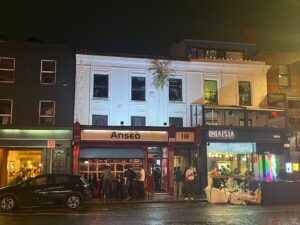 On our perambulations around Dublin this week, we visit what feels like a proper dive bar…that is, assuming proper dive bars all have a few good local taps and a killer playlist. If so, then Anseo is, indeed, in that category. But its slightly-scrubby-yet-cheerful interior doesn’t entirely hide the building’s history: this is a mid-18th century house, complete with a few extant interior features, that’s been repurposed as a pub since the mid-19th century. If you
  You are most likely to be visiting Anseo to catch a gig from an up-and-coming band or artist, or, perhaps, seeing some stand-up comedy upstairs; you may also be doing a
 As regular readers know, we are always on the lookout for
  While the ‘since 1793’ date is a little shaky, given the current building’s construction
  So, ghosts aside, what is the pub like? Well…most definitely not creepy. If anything, it’s a bit too polished to feel at all like a liminal space. There are several very different sections of the pub with their own character, but none are especially dark or gloomy. The front is much more ‘pubby’ and the rear more of a restaurant or hotel bar vibe (the many large TV screens are part of what gives that impression), though it’s worth knowing that the back bar is where the sole local-craft-beer representative is; there’s a Rye River tap if you know where to look. Indeed, the food was very good – a step up from a lot of pub food, though the enormous portions are perhaps created more for tourists than locals. There’s also the usual Guinness – and Murphy’s – plus some Warsteiner.
 There’s a covered outdoor space too, more
 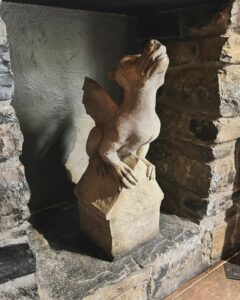 Perhaps surprisingly to some (certainly, to us), Dublin pubs do not contain a wealth of ghostlore. There are, of course,
 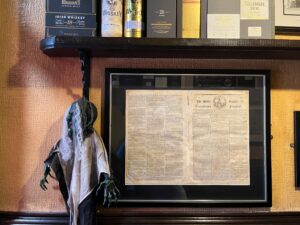 We’re less inclined toward the flashy, big-name haunting at
 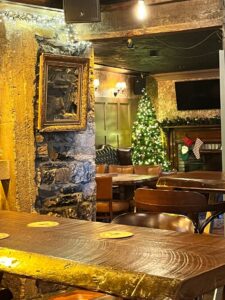 But we also want to shine the spectral spotlight on another pub whose apparitional associations are often overlooked: